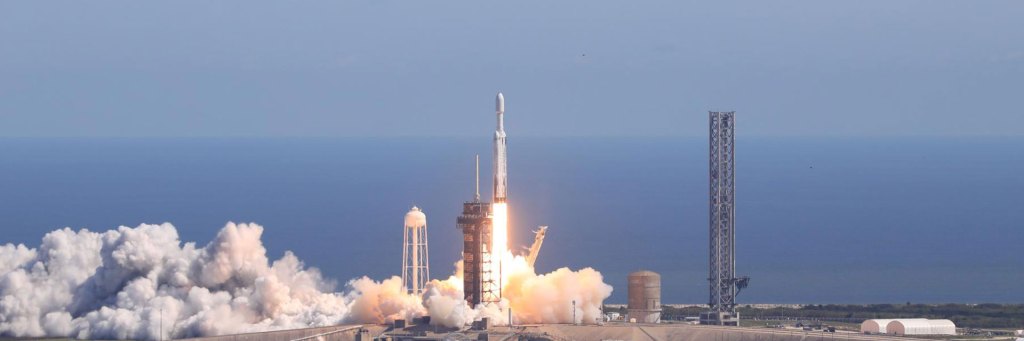
Europa Clipper lifts off aboard a Falcon Heavy on October 14, 2024.
NASA/Kim Shiflett · Original source · View full size ↗
Image provenance & review status
Photograph of the article's exact October 2024 launch event.
Source date: 2024-10-14 · Retrieved: 2026-09-16.
Exact-event NASA launch photograph; it records departure from Earth, not a completed Europa science result. Publication rights: owner review pending.
What happened
NASA reported that Europa Clipper launched on October 14, 2024 at 12:06 p.m. Eastern from Kennedy Space Center aboard a SpaceX Falcon Heavy. The mission is designed to investigate whether Jupiter’s icy moon Europa has conditions suitable for life. The dated launch-release photo caption recorded the then-planned route: a Mars flyby in February 2025, an Earth flyby in December 2026, and arrival at Jupiter in April 2030. Those waypoints were plans at launch, not outcomes already achieved or a statement of current mission status. NASA Science’s maintained mission page displays the launch photograph; NASA credits the image to Kim Shiflett. [1] [2]
Interpretation
A successful launch is a major milestone but only the first gate in an interplanetary program. The operational chain continues through cruise navigation, gravity assists, instrument commissioning, communication, and eventual observations. This matters commercially and institutionally because launch procurement, spacecraft manufacturing, mission operations, and scientific output carry different schedules and risks. A contractor can complete its launch task while the scientific question remains years from being answered. The useful lesson is to define success at each gate and avoid using the launch date as shorthand for mission completion. NASA’s account documents a real spacecraft leaving Earth; it does not claim Europa was found to support life. [1] [2]
What to watch
Check subsequent NASA mission updates against each planned flyby and arrival date, and distinguish trajectory adjustments from mission failure. Later, use instrument status and released data to evaluate whether the intended investigations occurred. A visual archive should caption the October liftoff as a launch image, not as a photograph of Europa or a completed science result. The 2024 event also illustrates why aerospace timelines should preserve plan and actual fields separately. This brief’s historical conclusion is narrow: the vehicle launched, and NASA published a multi-year route and scientific purpose. Questions about the moon’s habitability remain the mission’s subject, not a finding established by the launch. [1] [2]
Evidence limits
NASA release and NASA Science page align on launch; same agency, so this is a primary-source cross-check, not independent mission-outcome verification.
- Future waypoints were plans at launch, not completed events.
- No spacecraft health or scientific-result assessment beyond launch checked.
Sources & checked claims
- Liftoff! NASA’s Europa Clipper Sails Toward Ocean Moon of JupiterNASA · Source date: 2024-10-14 · Retrieved: 2026-09-16
Supports: October 14 launch date and time launch vehicle and site mission purpose then-planned February 2025 Mars and December 2026 Earth flybys then-planned April 2030 Jupiter arrival NASA/Kim Shiflett photo credit
Opened dated NASA launch release; the photo caption supplies the itinerary as a plan at launch, not current status.
- Europa Clipper HomepageNASA Science · Source date: not established · Retrieved: 2026-09-16
Supports: official launch photograph asset
Opened maintained mission page and clicked launch photo; page has no stable original publication date, so source date is null.
- Source publication
- 2024-10-14
- Event date
- 2024-10-14 (launch)
- Discovered / retrieved
- 2026-09-16
- Prepared
- 2026-09-16
- Site published
- Not established in the source record — draft retained
- Timeline date basis
- source-published
- Rewrite revision
- 1