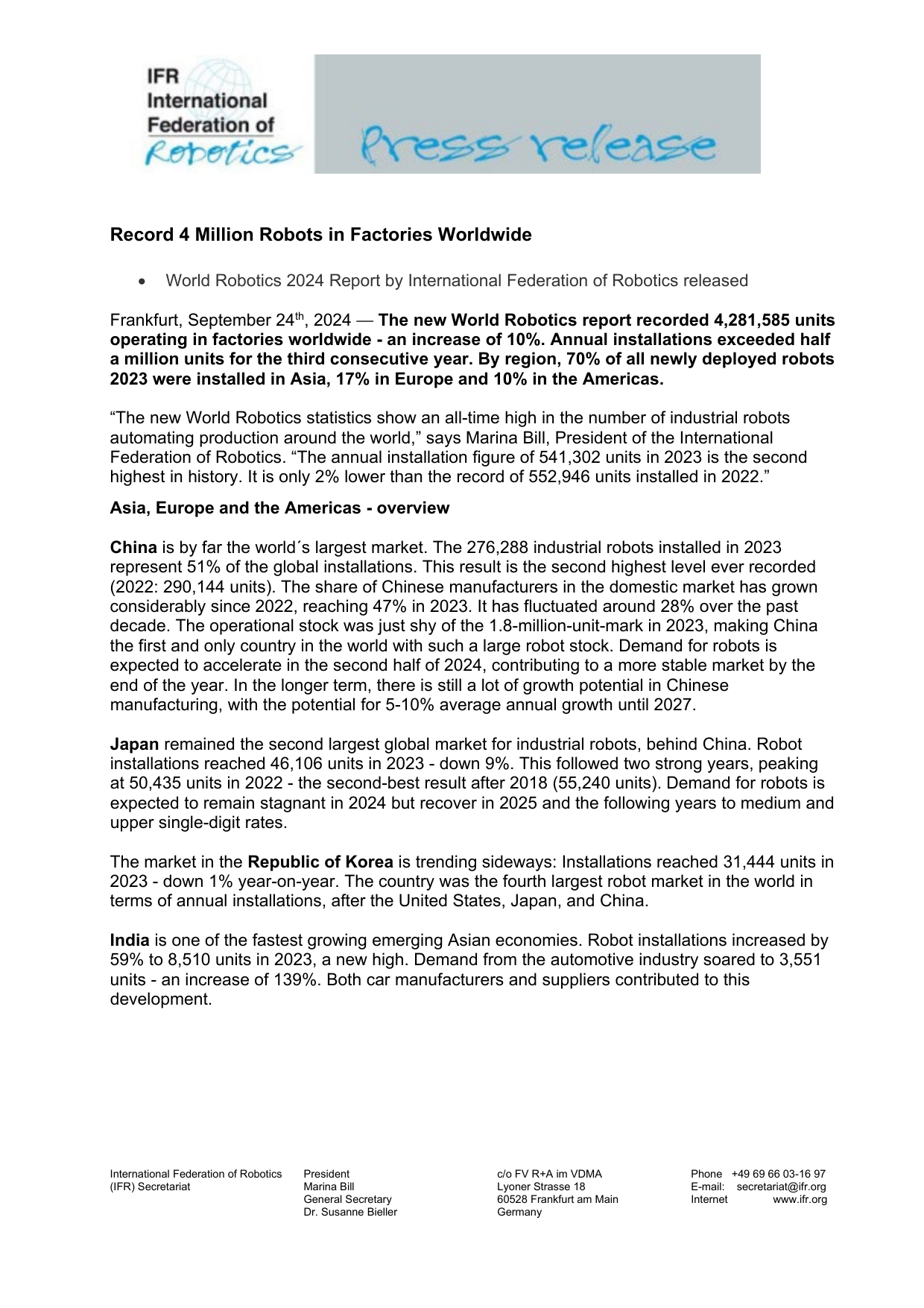
First-page document capture from the IFR's September 24, 2024 World Robotics release.
International Federation of Robotics · Original source · View full size ↗
Image provenance & review status
The release supplies the article's global operating-stock and annual-installation figures.
Source date: 2024-09-24 · Retrieved: 2026-09-16.
Faithful first-page capture of the official PDF, including its publisher marks and text; no watermark or label was removed. Publication rights: owner review pending.
What happened
The International Federation of Robotics reported 4,281,585 industrial robots operating in factories worldwide in its World Robotics 2024 release. That operational stock was 10% higher than a year earlier. New installations in 2023 totaled 541,302, the second-highest annual count in the series but below the 2022 record. Asia accounted for 70% of new installations, Europe 17%, and the Americas 10%. China alone installed 276,288 units, about 51% of the global total. The release is a retrospective industry count published in September 2024, not a claim that those machines were all newly purchased in 2024. [1]
Interpretation
The useful distinction is between a growing installed base and a flow of new equipment that can fluctuate with factory capital budgets. A vendor selling maintenance, integration, software, or training may see a different opportunity from one dependent on this year’s new unit orders. Regional concentration also means a global headline can conceal very different local conditions. A firm planning capacity should separate replacement work, expansion projects, and servicing of existing cells. This is an operational inference from the two measures, not a forecast that a given robotics supplier will grow. The federation’s aggregate figures do not disclose deployment quality, utilization, or payback for any customer. [1]
What to watch
Watch subsequent annual installation series alongside operating stock, and break both down by region and end-use industry before using the global figure in a sales plan. Ask whether installations represent genuinely new production capacity, replacement of aging systems, or a shift in supplier share. For any proposed deployment, the hard business test remains cycle time, uptime, integration cost, safety process, and labor availability at the particular site. The 2024 release makes the installed-base opportunity visible, but it cannot tell a factory whether a specific robot project clears that test. The strongest signal here is persistence of a large equipment base; the weaker claim is that its existence guarantees accelerating orders. [1]
Evidence limits
single_source: the publisher or issuing body is the sole checked source; independent outcomes remain unverified.
- Trade-association reporting is aggregate; no factory-level returns or independent audit checked.
- 2023 installations and September 2024 publication must not be conflated.
Sources & checked claims
- Record 4 Million Robots in Factories WorldwideInternational Federation of Robotics · Source date: 2024-09-24 · Retrieved: 2026-09-16
Supports: 4,281,585 operational stock 541,302 installations in 2023 regional installation shares China installation count
Opened four-page official press-release PDF; checked first-page figures and year labels.
- Source publication
- 2024-09-24
- Event date
- 2024-09-24 (announcement-or-report-release)
- Discovered / retrieved
- 2026-09-16
- Prepared
- 2026-09-16
- Site published
- Not established in the source record — draft retained
- Timeline date basis
- source-published
- Rewrite revision
- 1