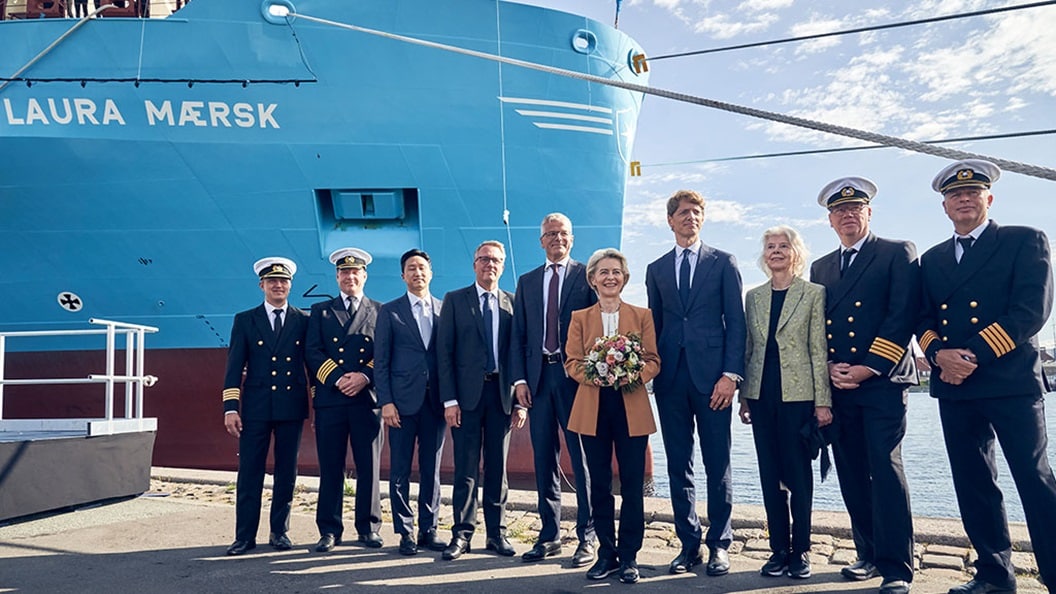
Maersk's official naming-ceremony photograph shows Laura Mærsk and ceremony participants in Copenhagen.
Maersk · Original source · View full size ↗
Image provenance & review status
Direct visual record of the named methanol-enabled vessel and its September 2023 ceremony.
Source date: 2023-09-14 · Retrieved: 2026-09-16.
Official event image supplied in the Maersk release; it does not establish fuel use, fuel provenance, or lifecycle emissions. Publication rights: owner review pending.
What happened
Maersk announced the naming of Laura Mærsk at a Copenhagen ceremony on September 14, 2023. The company described it as a 2,100-TEU methanol-enabled feeder container vessel and said it had 24 additional methanol vessels on order for delivery from 2024 through 2027. Maersk’s annual report later lists the naming and entry into service in September 2023, providing a second company record for the operational milestone. The report also describes the vessel’s first voyage from South Korea to Copenhagen as running entirely on green methanol, followed by feeder service. That is a specific reported voyage, not evidence that every later sailing used the same fuel. The order book likewise describes future capacity, not vessels already in service. [1] [2]
Interpretation
A dual-fuel vessel is more than a hull purchase. It needs an appropriate fuel supply, bunkering availability, crew procedures, route planning, and customer contracts that can absorb uncertain fuel costs. The event shows a concrete asset entering a network, while the 24-vessel order book shows intended scale rather than delivered capacity in 2023. This distinction is useful for any industrial transition: count operating equipment separately from orders, and assess the supply chain that lets the equipment use its designed capability. The inference does not establish that every voyage used methanol or that all fuel labelled green had the same origin and emissions profile. [1] [2]
What to watch
Follow vessel deliveries, actual fuel consumed by type, bunkering routes, and independently described fuel provenance. Compare capacity in service with the order book and with Maersk’s stated longer-term goals. For shippers, the operational question is whether a lower-emissions service can be reliably procured on required lanes, with clear accounting for the fuel used. A naming ceremony is a crisp historical date and the ship is a real visual subject, but neither proves a system-wide decarbonization outcome. This brief treats the September 2023 vessel as a case in coordinating assets and inputs, not as a blanket claim that maritime transport had solved its fuel challenge. [1] [2]
Evidence limits
Release and annual report are two Maersk records; they cross-check milestone timing but do not independently establish fuel use or climate impact.
- Company sources only; no voyage-level fuel evidence checked.
- A methanol-enabled engine does not establish the fuel mix actually used.
Sources & checked claims
- EU Commission President Names Landmark Methanol Vessel “Laura Mærsk”Maersk · Source date: 2023-09-14 · Retrieved: 2026-09-16
Supports: September 14 naming 2,100-TEU capacity additional vessel order book official ceremony image link
Opened dated company release and observed its image link; do not infer fuel usage from image.
- A.P. Moller - Maersk Annual Report 2023Maersk · Source date: 2024-02-08 · Retrieved: 2026-09-16
Supports: September 2023 naming and entry into service first South Korea-to-Copenhagen voyage on green methanol subsequent feeder service
Opened official annual-report PDF; company account of the first voyage, not independent fuel or emissions verification.
- Source publication
- 2023-09-14
- Event date
- 2023-09-14 (ceremony-and-service)
- Discovered / retrieved
- 2026-09-16
- Prepared
- 2026-09-16
- Site published
- Not established in the source record — draft retained
- Timeline date basis
- source-published
- Rewrite revision
- 1