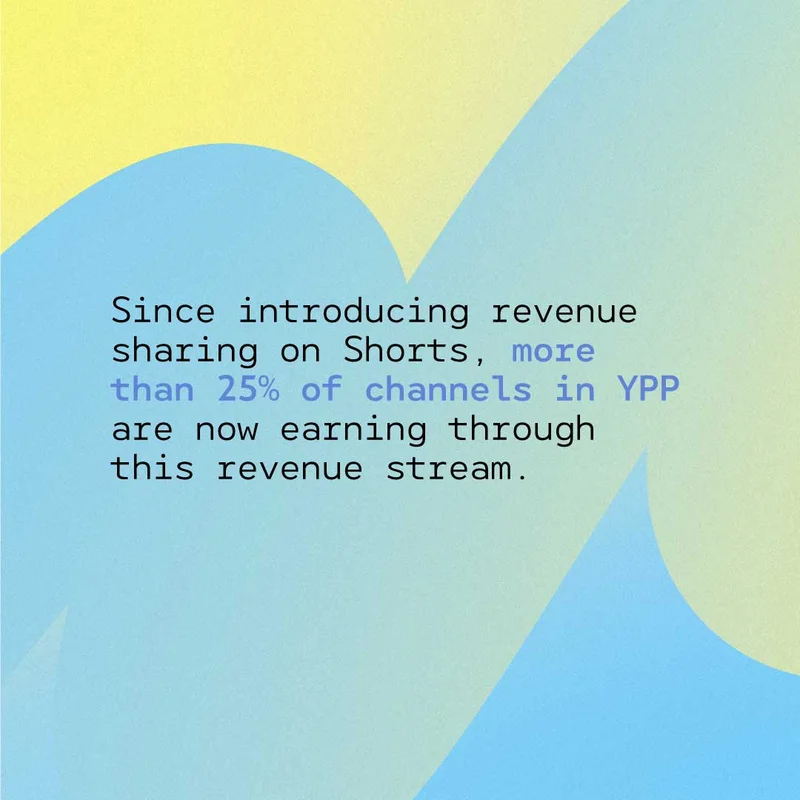
YouTube's first-party graphic accompanying its one-year Shorts revenue-sharing update.
YouTube / credit not listed on source page · Original source · View full size ↗
Image provenance & review status
Directly visualizes the article's cited more-than-25-percent YPP channel statistic.
Source date: 2024-03-28 · Retrieved: 2026-09-16.
Observed as an inline image in the official article; selected 800-pixel official rendition. Publication rights: owner review pending.
What happened
In a March 2024 update, YouTube marked roughly one year of Shorts advertising revenue sharing in its Partner Program. It said more than a quarter of channels in the program were earning through Shorts. It also said that more than 80% of creators who entered the program by meeting Shorts eligibility thresholds were earning through other YouTube monetization features as well. The post described multiple formats and income routes across the platform. These are platform-reported proportions of different channel groups, not a disclosure of median creator income, individual margins, or the share of all creators earning enough to support a business. [1]
Interpretation
The more interesting operational question is whether short video acts as a stand-alone profit center or an audience entry point into longer videos, memberships, shopping, and other formats. YouTube’s figures support the existence of overlap between Shorts-led entry and other monetization, but they do not establish why that overlap occurred. A creator team should therefore keep separate dashboards for reach, returning audience, revenue by format, production time, and conversion to owned relationships. A large view count can be valuable without converting into comparable income; the relative economics depend on content type and audience. This is an interpretation of platform design, not a promise that publishing Shorts will diversify revenue. [1]
What to watch
Look for cohort data that follows the same creators over time, including those who stop publishing or never reach program eligibility. Track revenue per unit of production effort and the share of earnings tied to any single platform feature. If using the March 2024 statistic, retain its denominator: channels already in the YouTube Partner Program. It says nothing directly about the entire creator population. Operationally, creators can test short-form discovery while building a broader content and income mix, but a decision to add a format needs actual workflow costs and audience behavior. The signal is a platform expanding participation in short-form monetization; sustainable creator income remains an open measurement problem. [1]
Evidence limits
single_source: the publisher or issuing body is the sole checked source; independent outcomes remain unverified.
- YouTube self-reported participation figures; no income distribution checked.
- Eligibility and survivor effects limit extrapolation to all creators.
Sources & checked claims
- One year in, revenue sharing on Shorts shows how your passion on YouTube pays offYouTube · Source date: 2024-03-28 · Retrieved: 2026-09-16
Supports: one-year Shorts revenue-share update more than 25% of YPP channels earning through Shorts more than 80% cross-feature earnings for Shorts-threshold entrants
Opened official dated platform post; retained the distinct denominators.
- Source publication
- 2024-03-28
- Event date
- 2024-03-28 (announcement-or-report-release)
- Discovered / retrieved
- 2026-09-16
- Prepared
- 2026-09-16
- Site published
- Not established in the source record — draft retained
- Timeline date basis
- source-published
- Rewrite revision
- 1