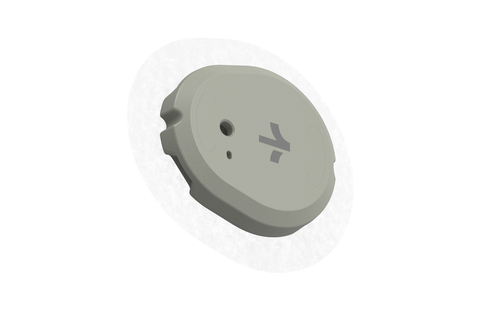
Official Stelo product image accompanying Dexcom's March 2024 clearance announcement.
Dexcom / Business Wire · Original source · View full size ↗
Image provenance & review status
Depicts the specific glucose biosensor cleared for over-the-counter marketing.
Source date: 2024-03-05 · Retrieved: 2026-09-16.
Official manufacturer-announcement asset supplied in the research record; the image depicts the product, not clinical use or an outcome. Publication rights: owner review pending.
What happened
The U.S. Food and Drug Administration announced on March 5, 2024 that it had cleared the Dexcom Stelo Glucose Biosensor System for over-the-counter marketing. The agency described it as an integrated continuous glucose monitor intended for adults 18 and older who do not use insulin. It explicitly said the device is not intended for people with problematic low blood glucose, because it does not provide an alert for that condition. Dexcom’s same-day announcement described a wearable sensor sending readings to a smartphone and said commercial availability was planned for summer 2024. Clearance, product design, and projected retail availability are separate claims. The official regulator and manufacturer pages align on the clearance and target user, but neither establishes eventual demand. [1] [2]
Interpretation
The operational shift is distribution and onboarding. Removing a prescription requirement for this specified population can allow a different purchase journey, with packaging, instructions, customer support, and app setup taking on more of the explanatory work. That raises concrete product questions: can buyers identify whether the device is suitable for them, understand what the readings mean, and recognize what it cannot do? The FDA’s explicit low-glucose limitation belongs in any description of the product. This is an analysis of the clearance and channel design, not medical guidance or a claim that users will achieve better health outcomes. A device can be authorized for sale before the market develops reliable use patterns. [1] [2]
What to watch
Track a dated product launch separately from the March clearance, then look for measured uptake, persistence of use, support burden, and independently evaluated outcomes within the intended population. Check that marketing and retail pages preserve the FDA’s intended-use boundary and alert limitation. If the product or labeling later changes, do not silently map those changes back to the 2024 event. The historical signal is a regulator opening a nonprescription path for a specific sensor and user group, while the manufacturer planned distribution. It is not proof that a sensor is appropriate for every adult or that continuous monitoring by itself improves care. [1] [2]
Evidence limits
FDA and Dexcom independently state the clearance and intended population; later uptake and clinical outcomes were not checked.
- No clinical effectiveness or consumer-adoption assessment performed.
- Historical clearance does not define current labeling or personal suitability.
Sources & checked claims
- FDA Clears First Over-the-Counter Continuous Glucose MonitorU.S. Food and Drug Administration · Source date: 2024-03-05 · Retrieved: 2026-09-16
Supports: March 5 clearance adult non-insulin intended population problematic-hypoglycemia limitation
Opened official FDA clearance announcement; checked intended-use exclusions.
- Stelo by Dexcom First Glucose Biosensor Cleared by FDA as Over-the-CounterDexcom · Source date: 2024-03-05 · Retrieved: 2026-09-16
Supports: same-day manufacturer announcement wearable-to-smartphone design summer availability as plan official Stelo product image
Opened manufacturer release and followed its labeled product-image link; availability is prospective in this source.
- Source publication
- 2024-03-05
- Event date
- 2024-03-05 (announcement-or-report-release)
- Discovered / retrieved
- 2026-09-16
- Prepared
- 2026-09-16
- Site published
- Not established in the source record — draft retained
- Timeline date basis
- source-published
- Rewrite revision
- 1