wealthmorning.com · Original source page
Image provenance
Inherited source visual. Image capture date and exact event relationship were not established again in this expansion. Owner publication review pending; credit does not grant permission.
Original assetThe signal
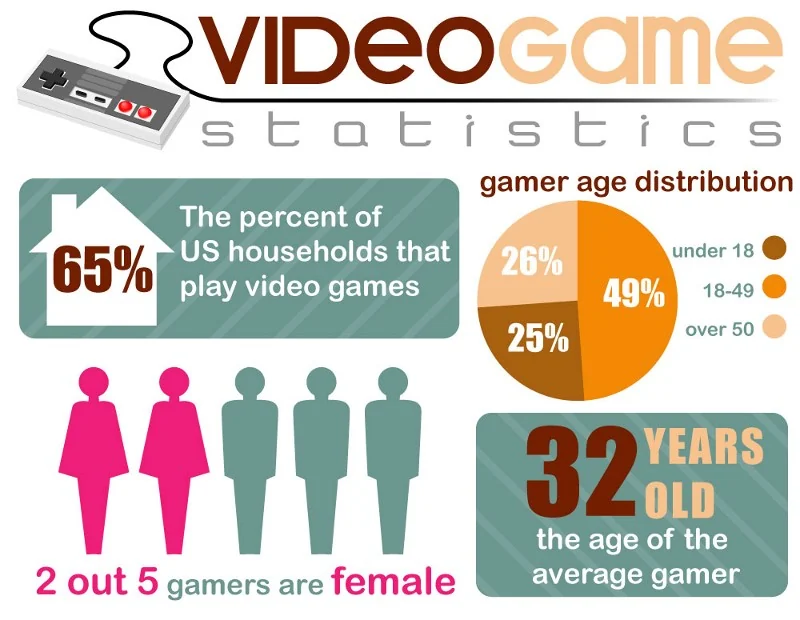
The Entertainment Software Association released its 2023 Essential Facts About the U.S. Video Game Industry report in July 2023, stating that 212.6 million Americans - 65% of the population - play video games at least one hour a week, in the gaming sector this desk tracks alongside media. The report itself states that research firm Circana conducted the underlying survey in April 2023, gathering data from approximately 4,000 Americans using an online methodology, with supplementary figures from the Entertainment Software Rating Board and Sensor Tower.
The evidence
A sample of roughly 4,000 respondents, however carefully weighted, is a survey, not a census: it produces an estimate with sampling uncertainty, not an exact count of players. The report states the average player is 32 years old and has played for 21 years, that 53% of players are male and 46% female, and that total US consumer spending on games reached $56.6 billion in 2022, down from $59.6 billion in 2021, split into console ($6.6bn), content ($47.5bn) and accessories ($2.5bn) - spending figures the report attributes to Circana's separate retail-tracking data rather than the player survey itself. The ESA's web page for the report restates the $56.6 billion figure, consistent corroboration between the association's own PDF and its website.
Timeframe and confidence
The player-behaviour figures (212.6 million, 65%, average age and tenure) rest on the April 2023 survey wave alone, a single fieldwork period rather than a tracked series, which limits how much one year's figure can say about a trend. The spending figures draw on Circana's retail-panel data, a different and generally more robust measurement approach than a self-reported survey, so the two halves of the report carry different confidence levels even though they are presented together.
What would change the reading
A published methodology note disclosing the survey's margin of error and weighting scheme would allow a real assessment of precision. Comparing the 65% participation figure against a second, independently fielded survey, or against platform-reported active-account figures, would show whether ESA's figure is representative or an outlier of its own method.
- What is the survey's margin of error, and how is the sample weighted to the US population?
- Do platform-level active-user disclosures support a similar participation rate?
- How has the $56.6 billion spending figure moved in the years since, and does the decline from 2021 persist?
An industry association's own survey is a legitimate primary source for what it measured, but it is also produced by a body whose members benefit from a large, growing-sounding number. Reading the participation rate as a self-reported estimate, not a verified count, is the more defensible frame.
Source trail
- 2023 Essential Facts About the U.S. Video Game Industrywww.theesa.com · Source publication: 2023-07-01 · Retrieved 2026-09-16
States the survey methodology (Circana, April 2023, approximately 4,000 respondents), the 212.6 million weekly player figure, demographic breakdowns and 2022 consumer spending figures.
- Essential Facts About the US Video Game Industry: 2023 Datawww.theesa.com · Source publication: not established · Retrieved 2026-09-16
Corroborates the 2022 consumer spending total of $56.6 billion and its breakdown as also stated in the full report.
- Event date
- 2023-07-01
- First source date
- 2023-07-01
- Source-record publication
- Not supplied — draft retained
- Preparation
- 2026-09-16