thehackerwire.com · Original source page
Image provenance
Inherited source visual. Image capture date and exact event relationship were not established again in this expansion. Owner publication review pending; credit does not grant permission.
Original assetThe signal
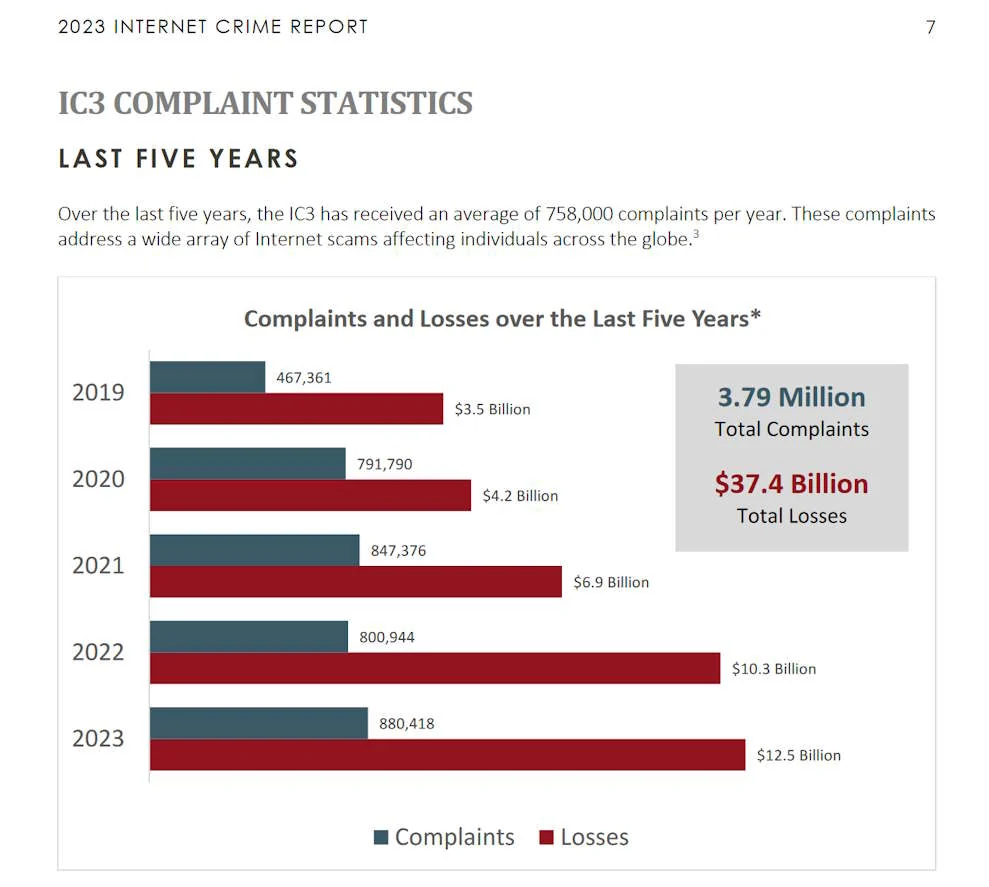
On 18 March 2024, the FBI's Internet Crime Complaint Center released its 2023 Internet Crime Report, the cybersecurity sector's most-cited annual count of complaints filed by the American public. The report states that IC3 received 880,418 complaints in 2023, with potential losses exceeding $12.5 billion for the year, a series the agency has published since 2019. That represents a nearly 10% rise in complaint volume and a 22% rise in reported losses against 2022. Investment fraud remained the costliest category at $4.57 billion, up 38% from $3.31 billion the year before; business email compromise followed at $2.9 billion across 21,489 complaints, with tech-support scams third.
The evidence
The report measures complaints, not incidents or confirmed losses: a single scheme can generate several complaints, and the same complainant can file more than once, a limitation the report's own appendix states directly. IC3 analysts assign a crime type and adjust each stated loss figure, and classifications “can change” as investigations proceed, meaning the published total is a reviewed estimate rather than a raw tally. The public service announcement accompanying the release confirms the headline figures word for word and frames both as records. The report's own introduction adds a separate data point: when the FBI infiltrated the Hive ransomware group's infrastructure, agents found that only about 20% of Hive's victims had reported to law enforcement at all, an internal comparison rather than a study of IC3 filings specifically, but one the report cites as reason to treat its own totals as conservative.
Timeframe and confidence
The complaint and loss series covers calendar year 2023 and follows the same structure as the four prior annual reports, which supports reading the year-over-year percentage changes as a genuine movement in reported activity rather than a methodology break. This is an editorial reading, but a reasonably confident one: confidence in the direction of the trend is higher than confidence in its absolute level, since the report documents duplicate filings and an unmeasured population of crime that is never reported to IC3 at all.
What would change the reading
A future report in which complaint counts and losses move in different directions, for instance fewer complaints but higher losses, would suggest rising loss-per-incident rather than rising incident volume. A revised methodology note on how IC3 identifies duplicate complaints would change how comparable the series is across years. Independent corroboration, such as bank-reported fraud figures or a payments-industry loss series covering the same period, would help show whether the IC3 trend reflects more crime, more reporting, or both.
- Is a year-over-year increase driven by more crime, more reporting, or a change in classification practice?
- Does the loss figure double-count activity a bank, exchange or platform also reports through its own channel?
- What share of a sector's true losses does a voluntary complaint system like IC3 likely capture?
The 2023 IC3 report is a useful, consistent series for tracking direction, but its own caveats about duplicate filings and underreporting mean the $12.5 billion figure should be read as a floor on a larger, unmeasured total rather than a complete accounting of the sector's actual losses.
Source trail
- 2023 Internet Crime Reportwww.ic3.gov · Source publication: not established · Retrieved 2026-09-16
States the 2023 complaint count, loss total, top crime categories by loss, and the report's own duplicate-filing caveat.
- IC3 Annual Report and Fraud Flyerwww.ic3.gov · Source publication: 2024-03-18 · Retrieved 2026-09-16
Confirms the release date and headline 2023 figures (880,418 complaints, over $12.5 billion in losses).
- Event date
- 2024-03-18
- First source date
- 2024-03-18
- Source-record publication
- Not supplied — draft retained
- Preparation
- 2026-09-16