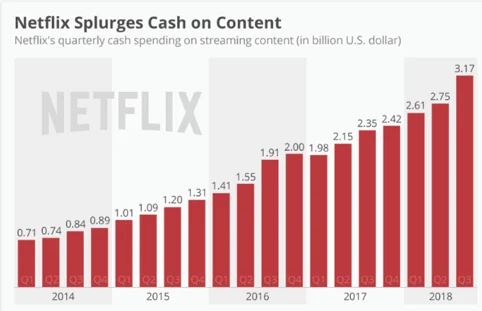
cdn1.investingdaily.com · Original source page
Image provenance
Inherited source visual. Image capture date and exact event relationship were not established again in this expansion. Owner publication review pending; credit does not grant permission.
Original assetThe signal
Signal Atlas's 14 Media sector logs a balance-sheet crossing from the filing season that closed out 2018. Netflix's Form 10-K for fiscal 2018, filed with the SEC on 29 January 2019, states total content assets, net, of $20,112,140 thousand as of 31 December 2018, up from $14,681,989 thousand a year earlier, alongside total content liabilities of $8,445,045 thousand, up from $7,502,837 thousand in 2017. Those are balance-sheet stocks, the value of content already licensed or produced sitting on the books, not a single year's cash spend, though the same filing separately reports net cash used in operating activities of $2.68 billion for 2018, worse than $1.79 billion used in 2017.
The evidence
The filing's own content-obligations note draws a boundary that a headline figure erases: it states that the $8.4 billion of total content liabilities "as reflected on our consolidated balance sheet" does not include "streaming content commitments that do not meet the criteria for liability recognition, the amounts of which are significant." The disclosed number is therefore a floor, not a ceiling, on what Netflix owed for content at year-end. The filing also states that "our content costs are largely fixed in nature and contracted over several years," the mechanism behind the growing liability: Netflix commits to content spending years ahead of knowing whether subscribers will judge it worthwhile. Netflix's own SEC filings index, as retrieved on 16 September 2026, remains the living reference where later 10-Ks and their revised content-obligation notes are published for comparison.
Timeframe and confidence
This is an editorial reading: the dollar figures come directly from an audited annual filing, so confidence in the reported stocks is high. Confidence in any comparison to "a studio's" spending is lower, because major film and television studios typically sit inside diversified conglomerates that do not isolate content assets and liabilities on a comparable basis, making a like-for-like balance-sheet comparison harder than the shorthand framing suggests.
What would change the reading
A later 10-K quantifying the unbooked, "significant" off-balance-sheet content commitments in dollar terms would let a reader judge how large the undisclosed amount actually was; a filing showing content liabilities growth slowing or reversing would suggest the fixed-commitment model had reached a plateau rather than continuing to expand.
- Does a reported content figure sit on the balance sheet, or is it described only as "significant" but left unquantified in a note?
- Is a cash-flow figure being compared with an accrual-basis balance-sheet figure as though they measured the same thing?
- What entity is actually being compared to "a studio," and does it report content spending on a comparable basis?
The filing does not claim Netflix outspent any named studio; it discloses that Netflix's own content obligations grew faster than its cash from operations in 2018, a narrower and more checkable claim than the studio comparison usually attached to it.
Source trail
- Netflix, Inc. Form 10-K for the fiscal year ended December 31, 2018www.sec.gov · Source publication: 2019-01-29 · Retrieved 2026-09-16
States 2018 content assets, content liabilities, operating cash flow, and the off-balance-sheet commitments note.
- Netflix Investor Relations — SEC Filingsir.netflix.net · Source publication: not established · Retrieved 2026-09-16
Living index page confirming where subsequent Netflix SEC filings are published for comparison.
- Event date
- 2019-01-29
- First source date
- 2019-01-29
- Source-record publication
- Not supplied — draft retained
- Preparation
- 2026-09-16