anyconnect.wpenginepowered.com · Original source page
Image provenance
Inherited source visual. Image capture date and exact event relationship were not established again in this expansion. Owner publication review pending; credit does not grant permission.
Original assetThe signal
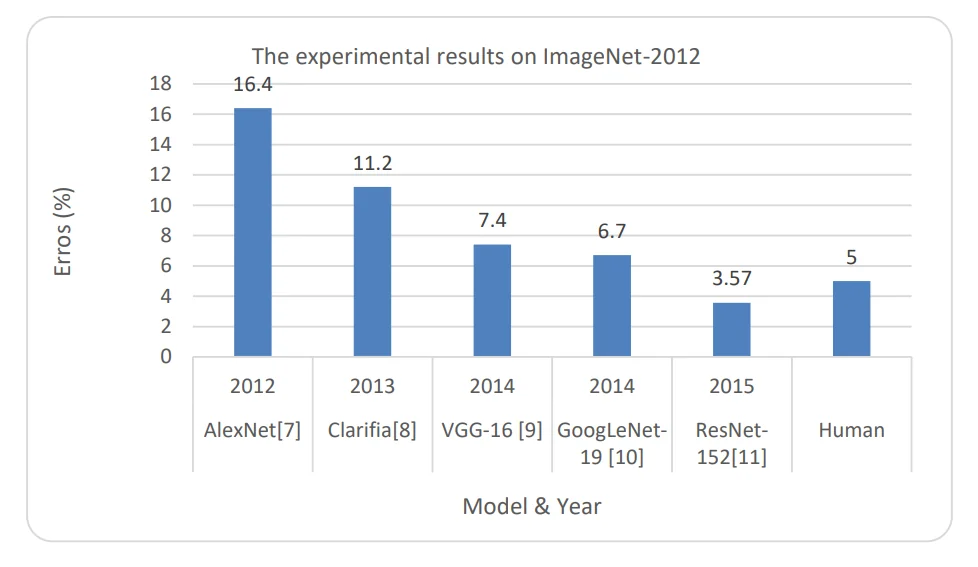
On 13 October 2012, the ImageNet Large Scale Visual Recognition Challenge published its full results table for that year's competition, part of Signal Atlas's AI sector. In the classification task, a team called SuperVision, from the University of Toronto, recorded a top-five error rate of 0.15315 using extra training data, and 0.16422 using only the data the organisers supplied. The next closest team, ISI, recorded 0.26172. The gap between first and second place, on the challenge's own scoring, was roughly eleven percentage points in a field where entries had previously separated by single points. The organisers' competition timeline confirms the full results were released that October, after a submission deadline extended to 30 September.
The evidence
The peer-reviewed account of the winning entry appeared afterwards as a paper in the NeurIPS 2012 proceedings, describing a convolutional network with 60 million parameters trained on GPUs. The paper states that a variant of this network, entered into the 2012 competition, achieved a 'winning top-5 test error rate of 15.3%', against 26.2% for the runner-up -- figures that match the results table within rounding. The same paper separately reports 37.5% top-one and 17.0% top-five error on the earlier 2010 version of the challenge, a different dataset split that should not be conflated with the 2012 figures. The two documents corroborate each other on the number that matters here: a single-year drop in error rate far larger than the incremental gains that had characterised the competition before it.
Timeframe and confidence
The evidence covers one competition cycle. A one-year result, however large, does not by itself establish a durable shift in method; it is strong evidence of a single outperformance, not yet a trend. This is an editorial reading: what makes the 2012 result a signal rather than an anomaly is that later years of the same challenge, and adoption of similar architectures elsewhere, would need to confirm it. The results table and paper are primary and consistent with one another, which supports confidence in the figures themselves; confidence in the broader claim that this changed the field's methods rests on evidence outside this pair of documents.
What would change the reading
A subsequent year in which non-convolutional approaches regained the top scores would weaken the reading of 2012 as a turning point. Continued, compounding error-rate reductions using related architectures in following challenges would strengthen it.
- Did the winning approach's error-rate advantage persist or widen in the next competition cycle?
- What other teams adopted comparable methods, and how quickly?
- Is a single benchmark's error rate a reliable proxy for real-world task performance?
The 2012 results table and the paper describing it are consistent, dated, and specific about what was measured. What they cannot do alone is prove significance beyond that single measurement; that requires watching whether the following years' results confirm the gap or narrow it.
Source trail
- ImageNet Large Scale Visual Recognition Competition 2012 (ILSVRC2012)image-net.org · Source publication: not established · Retrieved 2026-09-16
Gives the exact classification-task error rates for SuperVision (0.15315, 0.16422) and second-place ISI (0.26172).
- Large Scale Visual Recognition Challenge 2012 (ILSVRC2012)image-net.org · Source publication: 2012-10-13 · Retrieved 2026-09-16
Confirms the 13 October 2012 date on which full results were released, after the extended submission deadline.
- ImageNet Classification with Deep Convolutional Neural Networkspapers.nips.cc · Source publication: not established · Retrieved 2026-09-16
States the winning 15.3% top-5 test error versus 26.2% for the second-best entry, and separately the 2010-challenge error rates.
- Event date
- 2012-10-13
- First source date
- 2012-10-13
- Source-record publication
- Not supplied — draft retained
- Preparation
- 2026-09-16