gizmodo.com · Original source page
Image provenance
Inherited source visual. Image capture date and exact event relationship were not established again in this expansion. Owner publication review pending; credit does not grant permission.
Original assetThe signal
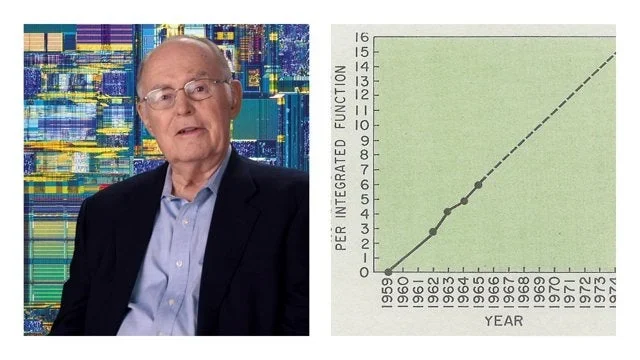
Filed to Signal Atlas's method desk, this entry reads the document usually cited as the origin of "Moore's Law." On 19 April 1965, the trade magazine Electronics published, in its Volume 38, Number 8, an article titled "Cramming more components onto integrated circuits" by Gordon E. Moore, then director of research and development at Fairchild Semiconductor. Moore wrote that "the complexity for minimum component costs has increased at a rate of roughly a factor of two per year" and forecast that this rate would hold "for at least 10 years," putting "the number of components per integrated circuit for minimum cost" at 65,000 by 1975.
The evidence
That is a forecast of annual doubling over a ten-year horizon, stated in the original text. Intel's own account of the law's history, presented as Intel's current company page on the subject as retrieved on 16 September 2026, states that "ten years later, in 1975, Moore revised this to doubling every two years," the slower rate most often quoted today. The original article is explicit about its own uncertainty: Moore wrote that "over the longer term, the rate of increase is a bit more uncertain," even while stating "there is no reason to believe it will not remain nearly constant" for the decade in question.
Timeframe and confidence
Both documents are primary: the original magazine article states the 1965 forecast in its own words, and Intel's account states the 1975 revision. Editorially, what makes this case distinctive among forecasts is that the semiconductor industry organised research and manufacturing investment around hitting the revised, biennial rate for decades afterward, which raises a separate question from whether the forecast was accurate: a target that industry planning is built around can become partly self-fulfilling, distinct from a forecast that simply turned out correct.
What would change the reading
Separating "accurate forecast" from "adopted planning target" would need a dated record of industry roadmaps citing the rate as a design goal, rather than only the after-the-fact observation that transistor counts tracked it for a long period.
- Was this figure originally stated as a forecast, or is it being read back into the record as one after the fact?
- Did the industry treat the rate as a target to plan around, which could make it partly self-fulfilling?
- Over what horizon did the original forecast claim confidence, and has that horizon been quietly extended in later retellings?
Moore forecast a ten-year run of annual doubling in 1965 and revised the rate himself a decade later. The distinction between a forecast that came true and a target an entire industry organised itself around is the lesson this document leaves for any other cited "law."
Source trail
- Cramming more components onto integrated circuitswww.monolithic3d.com · Source publication: 1965-04-19 · Retrieved 2026-09-16
The original 1965 Electronics article stating the forecast of a roughly annual doubling rate holding for at least ten years, reaching 65,000 components by 1975.
- Moore's Lawwww.intel.com · Source publication: not established · Retrieved 2026-09-16
States the 1975 revision of the doubling rate from annual to every two years.
- Event date
- 1965-04-19
- First source date
- 1965-04-19
- Source-record publication
- Not supplied — draft retained
- Preparation
- 2026-09-16