nasa.gov · Original source page
Image provenance
Inherited source visual. Image capture date and exact event relationship were not established again in this expansion. Owner publication review pending; credit does not grant permission.
Original assetThe signal
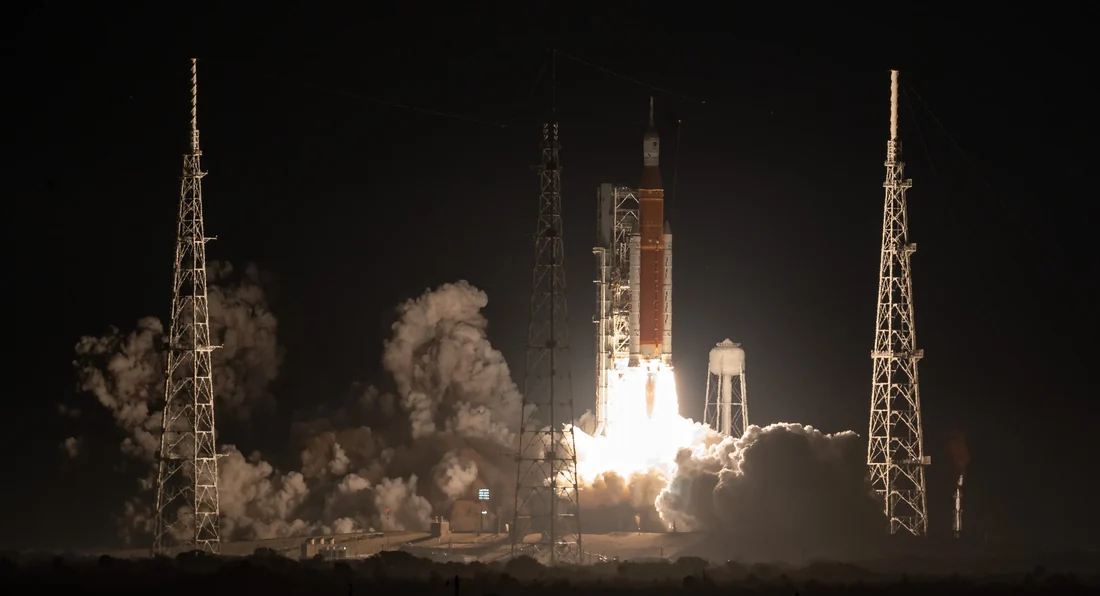
Artemis I, NASA's first integrated test of the Space Launch System rocket and Orion capsule, launched uncrewed on 16 November 2022 and splashed down on 11 December 2022, an aerospace-sector milestone in the agency's return to the Moon. NASA's own mission page records a flight of '25 days, 10 hours, and 53 minutes', covering 268,563 miles from Earth and travelling 43,471 miles beyond the Moon's far side, during which Orion 'accomplished 161 test objectives... including 20 objectives added mid-flight'. That is the completed-mission record. A year earlier, NASA's own Office of Inspector General had projected a different date.
The evidence
The OIG's audit report, published 15 November 2021, estimated that, given schedule slippage from COVID-19 disruption and technical issues including a lost power-and-data unit in Orion and a repeated Core Stage hot-fire test, 'we estimate NASA will be ready to launch by summer 2022 rather than November 2021 as planned'. The same report put the wider programme cost at a projected $93 billion through fiscal year 2025 and estimated the production and operating cost of a single SLS/Orion system at '$4.1 billion per launch for Artemis I through IV'. NASA's mission page, the second source, records what actually happened: a November 2022 launch, several months past the OIG's own 'summer 2022' projection, which itself had already been a downgrade from NASA's original November 2021 target. The two documents together show successive slip points rather than one.
Timeframe and confidence
Confidence in the launch and splashdown dates and mission statistics is high, because they come from NASA's own completed-mission record. Confidence in the $93 billion and $4.1 billion figures as a current cost is lower, because they are a November 2021 projection through fiscal 2025, not an audited actual, and the OIG report itself frames them as estimates built from budget documents rather than final accounts. Reading a 2021 cost projection as if it were a 2026 actual would overstate what is known; this record only supports treating it as the agency watchdog's stated estimate at the time.
What would change the reading
A later OIG audit, or a NASA financial statement, giving an audited actual cost per Artemis mission would show how the $4.1 billion estimate held up against delivered spending. A comparable schedule report for Artemis II or III, showing whether the pattern of successive short-term slips continued, would show whether the November 2022 outcome was a one-off recovery or part of a repeating pattern.
- How does the $4.1 billion estimated cost per SLS/Orion launch compare with the eventual, audited cost once more missions have flown?
- Did Artemis II and III slip by similar or larger margins relative to their own originally announced dates?
- What specific technical fixes, as opposed to schedule margin, closed the gap between the OIG's 'summer 2022' estimate and the actual November 2022 launch?
A mission that flies is a fact; a mission that flies later than a watchdog's own estimate is a pattern worth tracking across a programme, not a verdict on a single flight. The two documents opened here support the first and gesture at the second, without settling it.
Source trail
- Artemis Iwww.nasa.gov · Source publication: not established · Retrieved 2026-09-16
States the actual launch date, splashdown date, mission duration and completed test-objective count.
- NASA's Management of the Artemis Missions (IG-22-003)oig.nasa.gov · Source publication: 2021-11-15 · Retrieved 2026-09-16
Gives the OIG's 'summer 2022' launch projection, the $93 billion programme cost estimate, and the $4.1 billion per-launch estimate.
- Event date
- 2022-11-16
- First source date
- 2021-11-15
- Source-record publication
- Not supplied — draft retained
- Preparation
- 2026-09-16