blogger.googleusercontent.com · Original source page
Image provenance
Inherited source visual. Image capture date and exact event relationship were not established again in this expansion. Owner publication review pending; credit does not grant permission.
Original assetThe signal
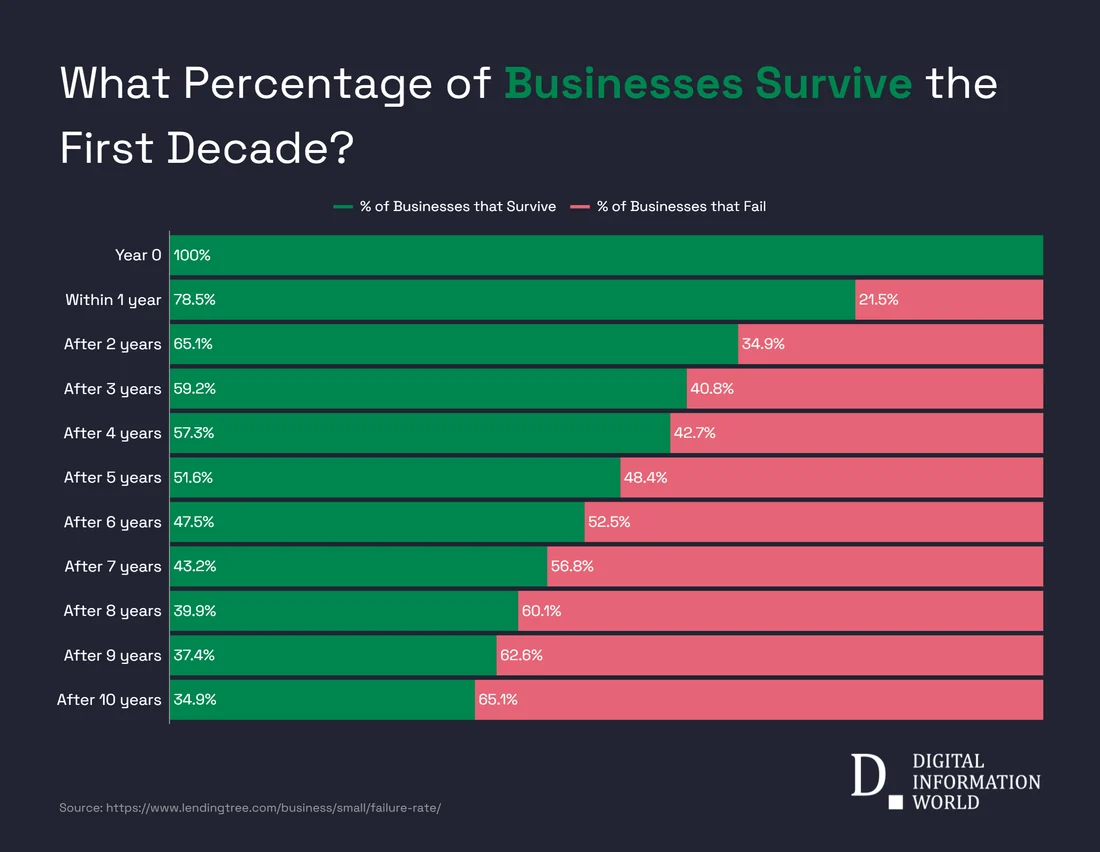
Sitting in Signal Atlas's method desk rather than any one sector, this entry asks what a reader should assume about a single company's odds before looking at its story. The Bureau of Labor Statistics tracks that question for the wider economy through its Business Employment Dynamics programme, which follows cohorts of newly opened private-sector establishments and reports, by opening quarter, how many are still operating in later quarters. Its survival-by-age table shows that of establishments opened in March 1994, 33.6% were still operating ten years later, in March 2004, and only 12.6% remained by March 2025, thirty-one years on. A cohort that opened twenty-one years later, in March 2015, shows a similar ten-year figure: 34.7% still operating in March 2025.
The evidence
That table measures the general population of new establishments, most never venture funded, so it is not itself a venture-capital outcome statistic. It is useful precisely because it is a large, transparent, government-run series with a stated method, unlike the more specific claim often repeated about venture-backed companies. The venture industry's own published output tends the other way: the National Venture Capital Association's quarterly Venture Monitor, produced with PitchBook, reports investment and fundraising totals and exit activity in aggregate, such as "US startups raised more than $400 billion in the first half of 2026," without publishing a denominator of how many funded companies did not exit successfully. A checkable base rate for venture outcomes specifically is not something either source opened for this entry supplies.
Timeframe and confidence
The BLS survival series is strong evidence for a general base rate: across two cohorts twenty-one years apart, roughly a third of new establishments were still open a decade later, a stable enough pattern to weight as a prior. Editorially, that base rate should be applied with caution to venture-backed companies specifically, since they are a selected, differently financed subset of all new establishments, and no source opened here publishes an equivalent survival table for that subset alone.
What would change the reading
A venture-specific survival or return table, published with the same transparency as the BLS series, naming its sample and method, would let a reader compare the general base rate against the selected one directly rather than inferring it from aggregate fundraising totals.
- Is this a base rate for all new firms, or for a narrower, self-selected group such as venture-backed companies?
- Does the source publish a denominator, the total number of attempts, or only the successes?
- How does a single company's outcome compare with the survival rate for its age cohort at the same point in time?
A third of new establishments were still open a decade after opening in both cohorts the BLS tracked. That is the base rate a single company's story should be measured against before any signal drawn from that story is trusted.
Source trail
- Business Employment Dynamicswww.bls.gov · Source publication: not established · Retrieved 2026-09-16
Describes the programme that tracks establishment-level gains, losses and survival across cohorts.
- Survival of Private Sector Establishments by Opening Yearwww.bls.gov · Source publication: not established · Retrieved 2026-09-16
Gives the exact ten-year and longer-run survival percentages for the March 1994 and March 2015 establishment cohorts.
- PitchBook-NVCA Venture Monitornvca.org · Source publication: not established · Retrieved 2026-09-16
Shows the venture industry's own published data is aggregate investment and exit activity, without a denominator of unsuccessful companies.
- Event date
- No single event
- First source date
- Unknown
- Source-record publication
- Not supplied — draft retained
- Preparation
- 2026-09-16