static.seekingalpha.com · Original source page
Image provenance
Inherited source visual. Image capture date and exact event relationship were not established again in this expansion. Owner publication review pending; credit does not grant permission.
Original assetThe signal
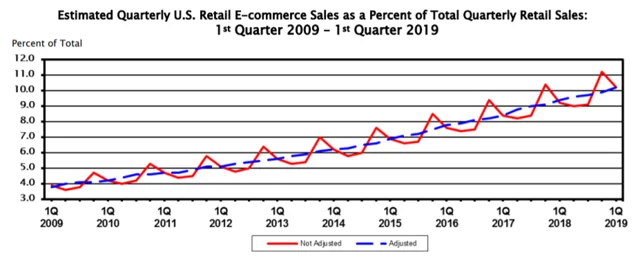
In consumer & society, and specifically in retail, the pandemic's effect on how people shopped shows up cleanly in one government series. The US Census Bureau states that in the second quarter of 2020, adjusted for seasonal variation, e-commerce sales accounted for 16.1% of total US retail sales, up from 11.8% in the first quarter of 2020. The same release states e-commerce sales rose 44.5% from the second quarter of 2019, while total retail sales fell 3.6% over the same period, meaning the entire retail pie shrank even as the online slice within it grew sharply.
The evidence
The Quarterly Retail E-Commerce Sales report is drawn from the same stratified sample of roughly 10,800 retail firms used for the Monthly Retail Trade Survey, benchmarked to a universe of more than two million retail firms; the Bureau states responding firms account for about 67% of the e-commerce estimate in any quarter, with the remainder imputed. A second release, covering the third quarter of 2020, adds the detail that matters most for reading the second quarter correctly: the adjusted e-commerce share fell back to 14.3% of total sales in Q3, down from 16.1% in Q2, even though e-commerce sales remained 36.7% above their year-earlier level. Total retail sales, meanwhile, rose 12.0% quarter-on-quarter as more categories reopened. Read on its own, the second-quarter figure could be mistaken for a permanent step change in shopping behaviour; read against the third quarter, it is better described as a spike driven by a temporarily shrunken denominator, partly reverting once total retail sales recovered.
Timeframe and confidence
Both releases are official statistical estimates with stated sampling error, giving high confidence in the reported percentages within their published margins. This is an editorial reading: two consecutive quarters showing a rise then a partial fall establish a reversion, not a reversal, since the third-quarter share of 14.3% remained well above the roughly 11% level seen in late 2019, and the series does not by itself show whether the elevated baseline further receded, held, or kept rising in subsequent quarters.
What would change the reading
Later quarterly releases showing the e-commerce share continuing to fall back toward pre-2020 levels would support reading the Q2 spike as a temporary shock. Releases showing the share resuming an upward climb from the post-reversion base would instead support reading the pandemic as having accelerated an existing trend rather than merely spiking it.
- Did the e-commerce share of retail sales keep falling after Q3 2020, or stabilise above its pre-pandemic path?
- How much of the Q2 2020 jump reflected categories, such as groceries, moving online only temporarily?
- What would the same quarters look like using not-adjusted rather than seasonally adjusted figures?
The two releases together show a single-quarter spike in a national statistical series that partly reverted within three months, a pattern a one-quarter reading alone would have missed entirely.
Source trail
- Quarterly Retail E-Commerce Sales, 2nd Quarter 2020www2.census.gov · Source publication: 2020-08-18 · Retrieved 2026-09-16
States adjusted e-commerce sales reached 16.1% of total retail sales in Q2 2020, up from 11.8% in Q1 2020, with e-commerce up 44.5% year-on-year while total retail sales fell 3.6%.
- Quarterly Retail E-Commerce Sales, 3rd Quarter 2020www2.census.gov · Source publication: 2020-11-19 · Retrieved 2026-09-16
States adjusted e-commerce share fell to 14.3% of total retail sales in Q3 2020 from 16.1% in Q2, a partial reversion even as e-commerce sales remained 36.7% above year-earlier levels.
- Event date
- 2020-08-18
- First source date
- 2020-08-18
- Source-record publication
- Not supplied — draft retained
- Preparation
- 2026-09-16