nm-magazine.nl · Original source page
Image provenance
Inherited source visual. Image capture date and exact event relationship were not established again in this expansion. Owner publication review pending; credit does not grant permission.
Original assetThe signal
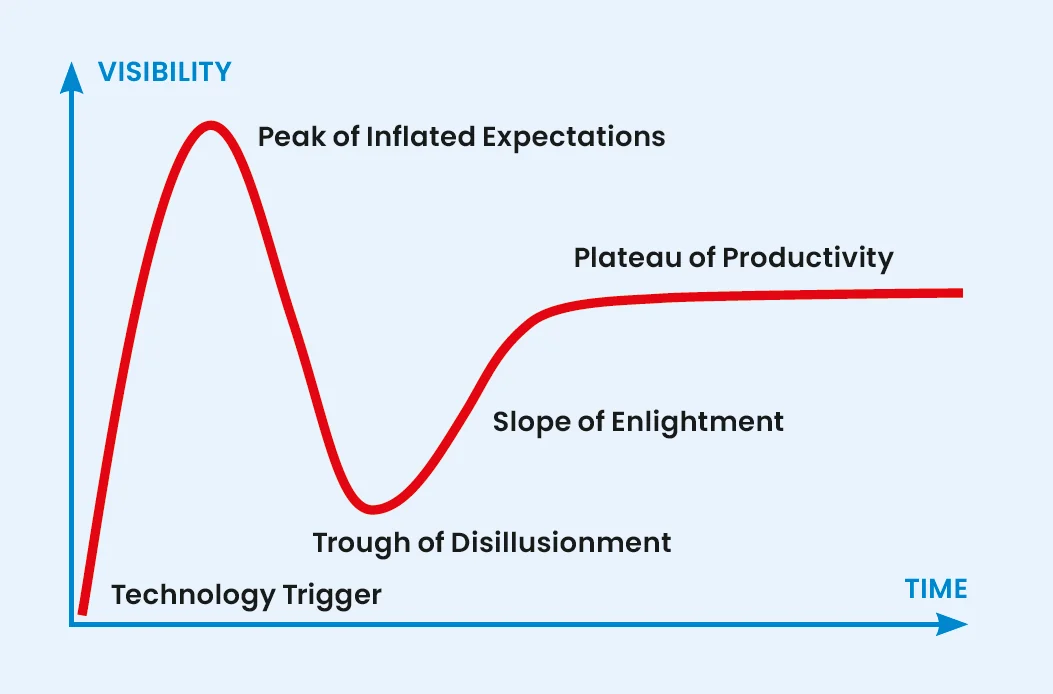
Signal Atlas files this entry under its method desk rather than a single industry, because the tool it examines is used across every sector the site covers. Gartner's own hype-cycle methodology page, as it stands on 16 September 2026, names five phases that a tracked technology is said to pass through: an Innovation Trigger, a Peak of Inflated Expectations, a Trough of Disillusionment, a Slope of Enlightenment and a Plateau of Productivity. The page describes each phase in a sentence or two and frames the whole chart as a way for a reader to decide whether to move early, move moderately, or wait for a technology to mature. That framing matters: the page presents itself as a decision aid, not as a published data series with a stated measurement behind each point.
The evidence
What the page does not say is at least as informative as what it does. It lists the phases and their general behaviour, then states plainly that the Hype Cycle research itself is reserved for paying clients, meaning the placement of a specific technology on a specific curve in a specific year is not shown. Gartner's broader methodologies overview page describes the firm's approach only in general terms, as research practices that "distill large volumes of data into clear, precise recommendations," without naming what data, what analyst process, or what review turns that data into a single dot on a curve. A reader can see the taxonomy. A reader cannot see the placement procedure, the underlying figures, or a retrospective record of how earlier placements for the same technology have moved.
Timeframe and confidence
This is an editorial reading, not a criticism of the taxonomy itself: naming a pattern of early excitement followed by disappointment followed by durable use describes something real that recurs across technologies. Confidence in that general pattern is reasonable. Confidence in any single placement is a different matter, because the page gives no date-stamped criterion against which a specific claim, such as a technology sitting in the trough in a given year, could be checked by an outside reader.
What would change the reading
The reading would strengthen if a published edition disclosed the dated evidence behind a placement, such as an installed-base figure, a revenue number or a client survey result, alongside a retrospective comparison to the same technology's position a year earlier. Absent that, a hype-cycle placement is best read as expert opinion, clearly labelled as such, rather than as a measurement.
- Is this placement accompanied by a dated figure, or by judgement alone?
- Has the same technology's position been compared with its position a year earlier?
- What would have to happen, and by when, for an outside reader to check the claim without access to the underlying paid research?
A hype-cycle chart is memorable because the five names describe something strategists recognise. That does not make a single placement on it a data point, and a signal built only on where something sits on the curve should be treated as one firm's dated opinion until a measurement is attached to it.
Source trail
- Gartner Hype Cycle Research Methodologywww.gartner.com · Source publication: not established · Retrieved 2026-09-16
States the five named phases and Gartner's own framing of what a Hype Cycle offers a reader, and that the underlying technology-specific research is reserved for paying clients.
- Business and Technology Insights Overviewwww.gartner.com · Source publication: not established · Retrieved 2026-09-16
Describes Gartner's methodologies in general terms as proprietary research practices, without disclosing a placement procedure for any specific chart.
- Event date
- No single event
- First source date
- Unknown
- Source-record publication
- Not supplied — draft retained
- Preparation
- 2026-09-16