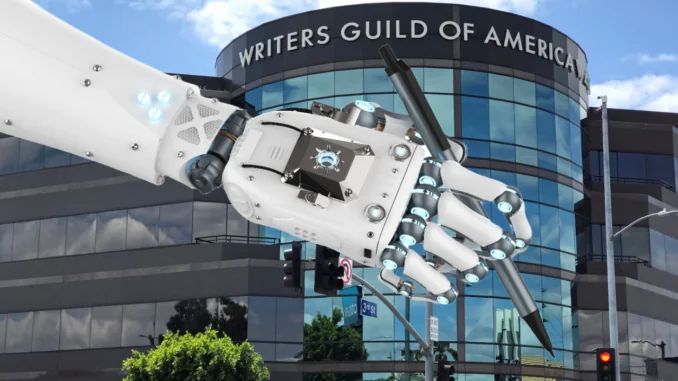
theawakenation.com · Original source page
Image provenance
Inherited source visual. Image capture date and exact event relationship were not established again in this expansion. Owner publication review pending; credit does not grant permission.
Original assetThe signal
On 25 September 2023, the Writers Guild of America and the Alliance of Motion Picture and Television Producers reached the Minimum Basic Agreement that ended a strike the Guild's own account puts at 148 days, in the media sector this desk tracks separately from gaming and hardware. The contract, running through 1 May 2026, contains the first union-negotiated terms on generative artificial intelligence in US screenwriting, according to the Guild's own summary of the deal.
The evidence
The summary states that AI cannot write or rewrite literary material and that AI-generated material will not be considered source material under the contract, which matters because source-material status affects a writer's credit and separated-rights payments. Writers may choose to use AI tools if a studio agrees and its policies allow it, but a company cannot require a writer to use software such as a generative model, and companies must disclose to a writer if material given to them was AI-generated. A companion page, the Guild's 'what we won' summary, restates these points and confirms the 148-day strike length and the ratification timing, though the Guild's original, broader proposal - a blanket ban on using writers' covered material to train AI - was not fully won; the final text instead preserves only a reserved right to argue the point under existing law.
Timeframe and confidence
Both documents are the Guild's own campaign materials, published to explain a ratified contract rather than to adjudicate a dispute, so they are a strong primary source for what the contract says, though naturally written from the side that negotiated it. The distinction between a categorical prohibition and a disclosure-and-consent regime is precise and appears consistently across both pages, which raises confidence that the summary reflects the contract's actual text rather than a looser paraphrase.
What would change the reading
A studio dispute or arbitration decision interpreting these clauses would show whether disclosure and source-material status hold up in practice. A subsequent Guild contract cycle either tightening or loosening these terms would indicate whether 2023's language was a floor or a ceiling for what writers could secure.
- How is AI-generated material defined when a writer substantially edits machine output?
- Has any studio been found to have violated the disclosure requirement since 2023?
- Did the reserved right to challenge AI training on writers' material lead to any legal action?
A labour contract is a negotiated compromise, not a technology ban: it tells a strategist what a specific, organised workforce could secure at a specific moment, and where the line between voluntary use and mandated tools was actually drawn.
Source trail
- Summary of the 2023 WGA MBAwww.wgacontract2023.org · Source publication: not established · Retrieved 2026-09-16
States the specific AI provisions of the 2023 contract: exclusion of AI output from source material status, voluntary writer use, and a company disclosure requirement.
- What We Wonwww.wgacontract2023.org · Source publication: not established · Retrieved 2026-09-16
Confirms the 148-day strike length and the tentative agreement date, and restates the AI protections in the ratified contract.
- Event date
- 2023-09-25
- First source date
- Unknown
- Source-record publication
- Not supplied — draft retained
- Preparation
- 2026-09-16