cdn.geekwire.com · Original source page
Image provenance
Inherited source visual. Image capture date and exact event relationship were not established again in this expansion. Owner publication review pending; credit does not grant permission.
Original assetThe signal
Signal Atlas's 02 Enterprise sector dates cloud computing's arrival as a disclosed line of business to a single quarterly filing. Amazon's Form 10-Q for the quarter ended 31 March 2015, filed 23 April 2015, states: "Beginning in the first quarter of 2015, we changed our reportable segments to North America, International, and AWS." Before that filing, Amazon Web Services' revenue and profitability were folded into consolidated results; after it, AWS's own net sales and operating income were visible as a distinct segment for the first time.
The evidence
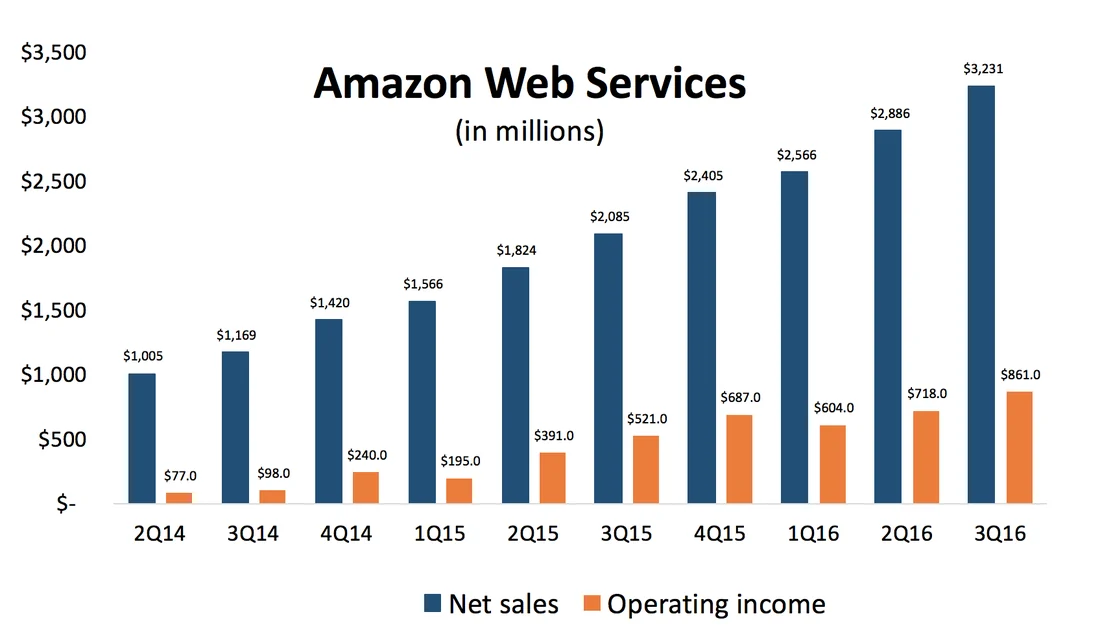
The filing's segment note gives the first comparative figures: AWS net sales of $1,566 million in the first quarter of 2015, up from $1,050 million a year earlier, with AWS operating income of $265 million against $245 million in the prior-year period. Set against the company's other two segments in the same note, North America operating income of $517 million and an International operating loss of $76 million, the disclosure showed AWS was Amazon's second-largest source of operating income that quarter despite being its smallest segment by revenue, a distinction between a segment's share of sales and its share of profit that consolidated reporting had previously obscured. AWS's own company history page, as retrieved on 16 September 2026, states the business has been operating "since launching in 2006," meaning roughly nine years passed before its financial performance was broken out on its own line.
Timeframe and confidence
This is an editorial reading: the segment figures come from an SEC-filed quarterly report, so confidence in the specific dollar amounts for that quarter is high. Confidence in any broader claim about why Amazon chose that particular quarter to change its segment reporting is lower, since the filing states the change without giving a reason, and segment-reporting changes commonly follow internal management-reporting changes a filing does not have to explain.
What would change the reading
A pattern of AWS operating income continuing to outpace AWS net-sales growth in subsequent quarterly filings would support reading the 2015 disclosure as the start of a durable margin advantage; a reversal, with AWS operating margin converging toward the retail segments', would suggest 2015 caught a temporary gap rather than a structural one.
- Did a company change its reportable segments, and does the filing state a reason, or only the fact of the change?
- Is a segment's share of total revenue being confused with its share of total operating income?
- How long had a business unit operated before its financials were first broken out as its own segment?
The first-quarter-2015 filing did not create AWS's profitability; it made a profitability that had already existed newly visible to anyone reading Amazon's public filings, which is why a first segment disclosure functions as a signal about disclosure choices as much as about the underlying business.
Source trail
- Amazon.com, Inc. Form 10-Q for the quarterly period ended March 31, 2015www.sec.gov · Source publication: 2015-04-23 · Retrieved 2026-09-16
First disclosure of AWS as a reportable segment, with comparative net sales and operating income figures.
- About AWSaws.amazon.com · Source publication: not established · Retrieved 2026-09-16
Living company page confirming AWS launched in 2006, ahead of its 2015 segment disclosure.
- Event date
- 2015-04-23
- First source date
- 2015-04-23
- Source-record publication
- Not supplied — draft retained
- Preparation
- 2026-09-16