assets.cmcmarkets.com · Original source page
Image provenance
Inherited source visual. Image capture date and exact event relationship were not established again in this expansion. Owner publication review pending; credit does not grant permission.
Original assetThe signal
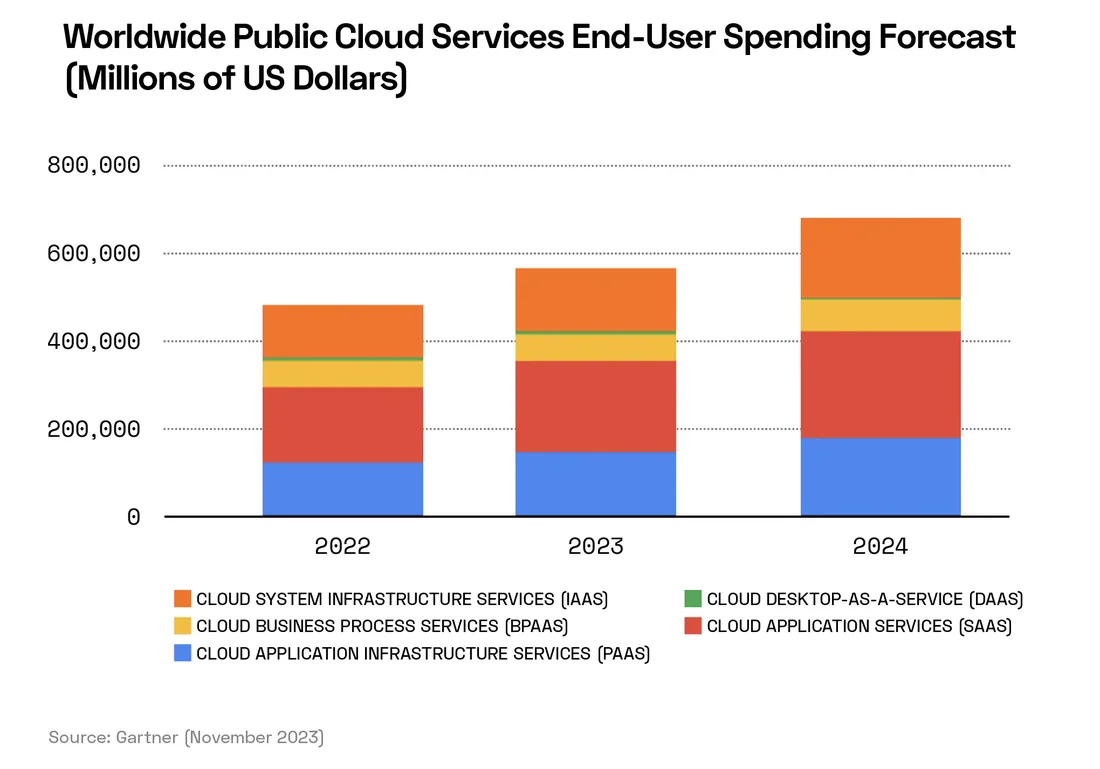
On 19 April 2023, Gartner forecast that worldwide public cloud end-user spending would grow 21.7% to $597.3 billion in 2023, up from $491 billion in 2022, part of Signal Atlas's enterprise software sector. The release's table splits the total across six service categories through 2024, with infrastructure-as-a-service forecast to grow fastest, at 30.9%, and software-as-a-service remaining the largest single category at a forecast $197.3 billion.
The evidence
The figure for 2023 was published four months into that year, meaning it is itself a forecast, not a final tally, despite naming the current year. Gartner names its own analyst, attributes the framing to generative AI's compute demands, and separately forecasts that '75%' of organisations will run a cloud-first digital transformation model by 2026 -- a second, more distant forecast nested inside coverage of the first. A different measurement basis appears in Amazon's Form 10-K for fiscal year 2023, filed 2 February 2024, which reports AWS net sales of $90,757 million, up 13% year over year -- an audited, single-company, revenue-recognised figure, not a market-wide end-user-spending estimate. The two numbers measure different things: Gartner estimates what customers across the whole market spend across many providers and layers of the stack; Amazon reports what one provider recognised as revenue from one segment. Neither figure can be used to check the other directly.
Timeframe and confidence
Confidence in the shape of the forecast -- growth continuing, IaaS outpacing SaaS in percentage terms -- is reasonable, because Gartner has published comparable forecasts across many prior years using a consistently named method. Confidence in the precise $597.3 billion figure as a final 2023 outcome is lower, because the source document is dated April 2023 and forecasts are revised as the year closes.
What would change the reading
A later Gartner release restating full-year 2023 spending, compared against this forecast, would show how far the April estimate held. A widening gap between Gartner's market total and the sum of major providers' disclosed cloud revenues would suggest the market estimate is not well anchored to filed figures.
- How much did Gartner's April 2023 forecast change when it issued a later, closer-to-year-end update?
- Does the sum of major cloud providers' disclosed segment revenue approximate Gartner's market total, or diverge from it?
- What does 'end-user spending' include that a single provider's recognised revenue would not?
A forecast published in April about the year already under way is still a forecast. Reading it as an outcome, rather than an estimate awaiting revision, is the error this pairing of sources is meant to prevent.
Source trail
- Gartner Forecasts Worldwide Public Cloud End-User Spending to Reach Nearly $600 Billion in 2023www.gartner.com · Source publication: 2023-04-19 · Retrieved 2026-09-16
States the $597.3 billion 2023 forecast, the 2022 baseline, segment growth rates, and a further 2026 adoption forecast.
- Amazon.com, Inc. Form 10-K (fiscal year ended December 31, 2023)www.sec.gov · Source publication: 2024-02-02 · Retrieved 2026-09-16
Provides AWS's audited 2023 net sales of $90,757 million as a contrasting, single-provider revenue measure.
- Event date
- 2023-04-19
- First source date
- 2023-04-19
- Source-record publication
- Not supplied — draft retained
- Preparation
- 2026-09-16