cdn.bcs-express.ru · Original source page
Image provenance
Inherited source visual. Image capture date and exact event relationship were not established again in this expansion. Owner publication review pending; credit does not grant permission.
Original assetThe signal
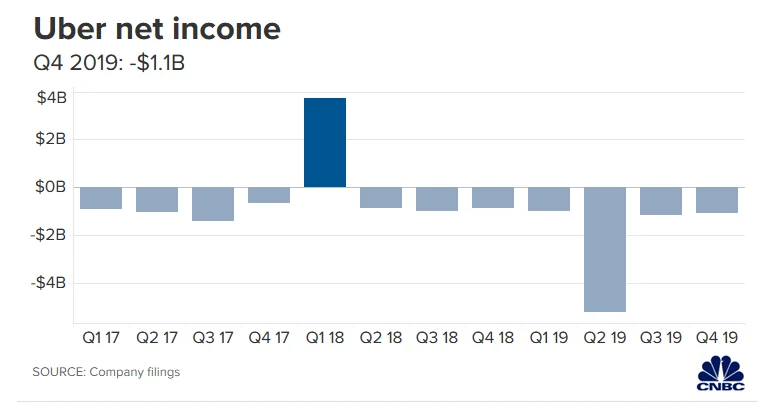
In Signal Atlas's 11 Venture sector, Uber's 2019 listing is remembered as a loss-making IPO, and the company's own filings show why that label needs a qualifier. Uber's Form S-1, filed with the SEC on 11 April 2019, reports 2018 revenue of $11,270 million, up 42% from $7,932 million in 2017, alongside gross bookings of $49.8 billion, up 45% from $34.4 billion. The same filing reports 2018 net income attributable to Uber of $997 million, a headline that, read alone, resembles a profit at the moment of listing.
The evidence
The filing's own figures complicate that reading. The $997 million net income figure sits alongside a $3,214 million gain on divestiture and a $1,996 million unrealised gain on investments recorded in other income, one-time items unrelated to running the ride-hailing and delivery business. Stripped of them, the S-1 discloses an operating loss of $3,033 million for 2018 and an accumulated deficit of $7,865 million as of 31 December 2018. Its risk factors state: "We have incurred significant losses since inception... we may not achieve profitability." The final prospectus, dated 9 May 2019, priced the offering at $45.00 per share for 180,000,000 shares, an $8.1 billion raise, confirming investors bought in at that price with the operating loss already disclosed in the same document set rather than hidden from them.
Timeframe and confidence
This is an editorial reading: the revenue, bookings, net income and operating loss figures come directly from an SEC-registered prospectus subject to liability for material misstatement, so confidence in the reported numbers is high. Confidence in any single "loss-making IPO" label is more a matter of which line a reader chooses to headline; net income, operating income and free cash flow tell different parts of the same story, and the filing discloses all three.
What would change the reading
A subsequent quarterly filing showing operating losses narrowing over several consecutive periods would support reading 2018's loss as a temporary scale-up cost; continued operating losses of similar size years after listing would support reading it as a structural feature of the business model rather than a one-off.
- Does a reported profit or loss reflect operating results, or does it include one-time gains and other income?
- Is gross bookings, the value of transactions on a platform, being confused with revenue, what the platform itself keeps?
- What did the accumulated deficit look like in the filings immediately before and after this one?
Uber's prospectus did not conceal its unit economics; it disclosed a growing top line, a large operating loss and a one-time-gain-inflated net income figure side by side, leaving "loss-making IPO" a reasonable summary of the operating reality even in a year the bottom-line figure said otherwise.
Source trail
- Uber Technologies, Inc. Form S-1 Registration Statementwww.sec.gov · Source publication: 2019-04-11 · Retrieved 2026-09-16
Discloses 2018 revenue, gross bookings, net income, one-time gains, operating loss and accumulated deficit.
- Uber Technologies, Inc. Prospectus (Rule 424(b)(4))www.sec.gov · Source publication: 2019-05-09 · Retrieved 2026-09-16
Confirms the IPO price, share count and offering size as priced on 9 May 2019.
- Event date
- 2019-05-09
- First source date
- 2019-04-11
- Source-record publication
- Not supplied — draft retained
- Preparation
- 2026-09-16