media.beehiiv.com · Original source page
Image provenance
Inherited source visual. Image capture date and exact event relationship were not established again in this expansion. Owner publication review pending; credit does not grant permission.
Original assetThe signal
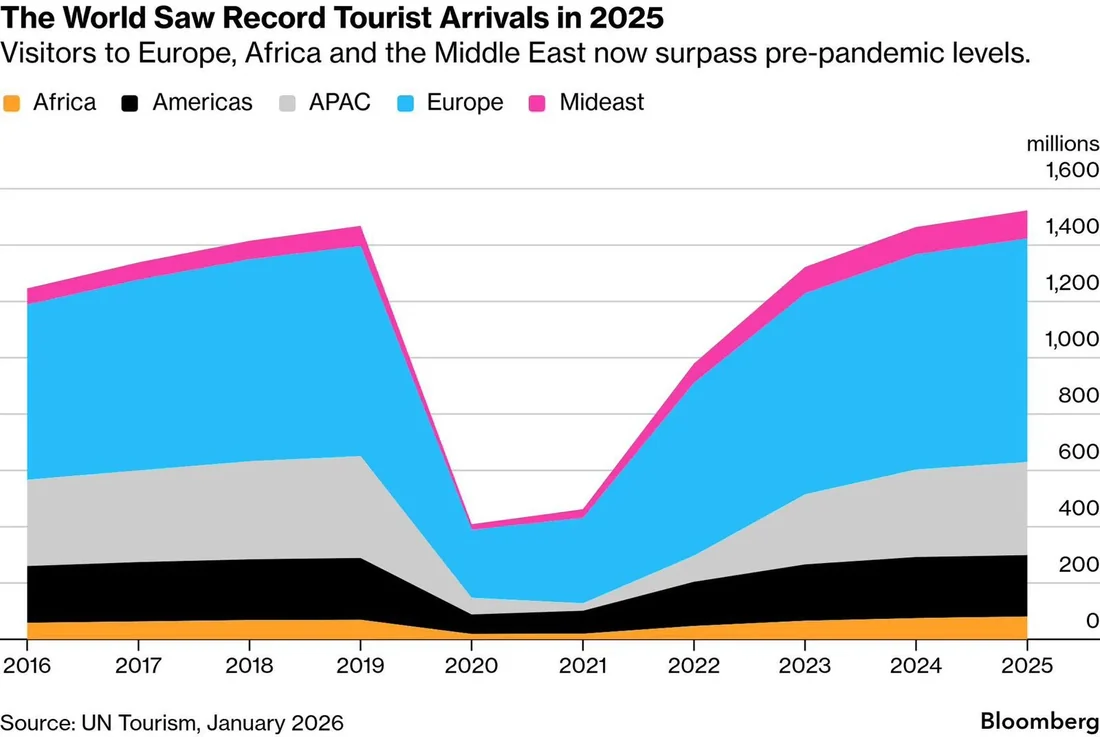
The World Tourism Organization (UN Tourism), the United Nations' specialised agency for the travel sector, reported in its World Tourism Barometer for January 2024 that an estimated 1,286 million international tourist arrivals were recorded worldwide in 2023, up 34% on 2022, putting international tourism at 88% of pre-pandemic 2019 levels. Recovery was uneven: the Middle East was the only region above 2019, at 122% of 2019 levels, while Europe reached 94%, Africa 96%, the Americas 90%, and Asia and the Pacific only 65%, with North-East Asia lagging at 55% against South Asia's 87%.
The evidence
The barometer compiles arrivals data from national tourism authorities into a standardised series UN Tourism has published since well before the pandemic, allowing this year's figures to be compared on a like-for-like basis against 2019. The same document separates arrivals, a volume measure, from spending: international tourism receipts reached an estimated US$1.4 trillion in 2023, about 93% of 2019's US$1.5 trillion, while tourism's direct contribution to global GDP is estimated at US$3.3 trillion, or 3% of world output, matching 2019's share. Arrivals and receipts recovering at different rates is expected, since a given number of trips can generate more or less spending depending on trip length, destination prices and traveller origin. A separate measure, from the International Air Transport Association, put full-year 2023 air passenger demand at 94.1% of 2019 levels, higher than the barometer's 88% arrivals figure; the barometer itself cites an IATA tracker showing only 87% recovery in air capacity through October, a reminder that a partial-year figure and a completed full-year figure are not directly comparable.
Timeframe and confidence
Both documents cover full-year 2023, are dated within the same month, and come from separate organisations using different measurement methods, arrivals against air-travel demand, arriving at the same broad picture of substantial but incomplete recovery. This is editorial reading: agreement between two independently compiled series on direction and rough magnitude is reasonably strong evidence for the recovery pattern, though both label their 2023 figures as preliminary or provisional pending later revision.
What would change the reading
The barometer's own follow-up edition, which it says was due in May 2024 with more comprehensive results, would show whether the provisional 88% figure was revised up or down, and whether Asia and the Pacific's lagging recovery had closed the gap with other regions.
- Did the May 2024 barometer revise the provisional 88% recovery figure, and in which direction?
- Did Asia and the Pacific's recovery gap close over the following year?
- Did receipts and direct tourism GDP catch up to arrivals, or did the gap between volume and spending persist?
Two independently produced 2023 travel measures pointing to substantial but incomplete recovery, each labelled provisional by its own publisher, is a reasonably strong but not final reading of where international tourism stood at that point.
Source trail
- UNWTO World Tourism Barometer, Volume 22, Issue 1, January 2024 (Excerpt)www.tourismticker.com · Source publication: 2024-01-18 · Retrieved 2026-09-16
UN Tourism's own barometer states 2023 international arrivals, the percentage of 2019 levels reached overall and by region, and tourism receipts and direct GDP estimates.
- Global Air Travel Demand Continued Its Bounce Back in 2023www.iata.org · Source publication: 2024-01-31 · Retrieved 2026-09-16
Provides a separate, aviation-industry measure of 2023 travel recovery for comparison against the barometer's tourist-arrival count.
- Event date
- 2024-01-18
- First source date
- 2024-01-18
- Source-record publication
- Not supplied — draft retained
- Preparation
- 2026-09-16