assets.aboutamazon.com · Original source page
Image provenance
Inherited source visual. Image capture date and exact event relationship were not established again in this expansion. Owner publication review pending; credit does not grant permission.
Original assetThe signal
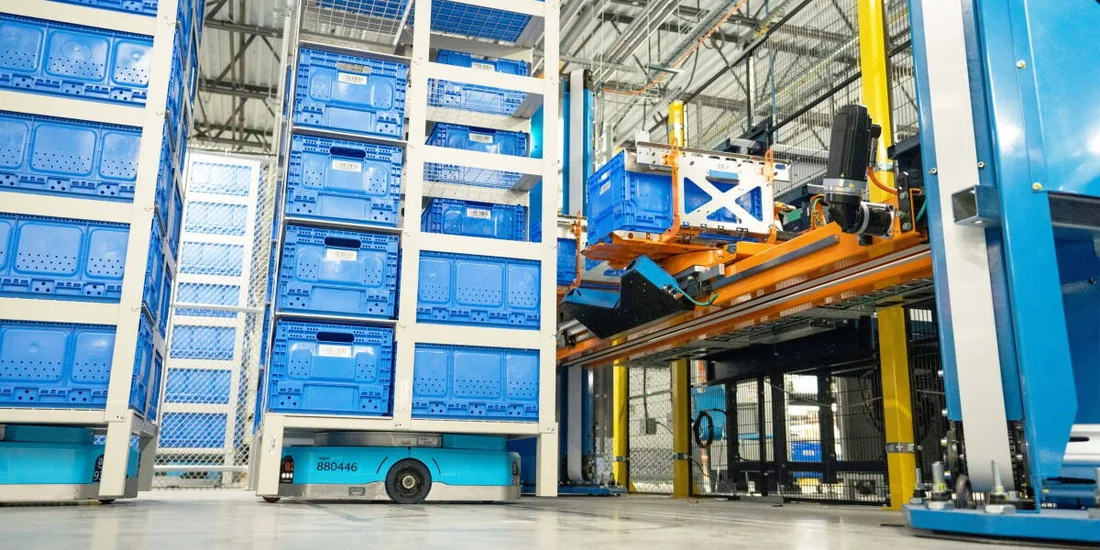
Amazon's own operations newsroom states the company has over 750,000 robots working collaboratively with our employees across its fulfilment network, a figure attributed to Scott Dresser, vice-president of Amazon Robotics, in an Amazon newsroom article on its robotics systems. The article carries no visible publication date, so it is treated here as a company statement retrieved on 16 September 2026 rather than pinned to a specific day, consistent with how this desk handles undated corporate disclosures in the robotics sector. The number sits alongside descriptions of several distinct machine types working together under a system Amazon calls Sequoia.
The evidence
What Amazon counts as a robot is broad by the article's own account: mobile drive units that move shelving, gantry systems that restock totes, robotic arms such as Sparrow and Cardinal that pick and consolidate items, autonomous mobile robots such as Proteus, and a bipedal machine, Digit, that can carry items while walking. A separate, similarly undated Amazon newsroom article on European expansion states that Proteus alone 'is currently deployed at 25 fulfillment centers', a concrete, narrower figure that illustrates the gap between a single model's footprint and the 750,000-unit aggregate spanning every category above.
Timeframe and confidence
Both sources are company-published, undated newsroom articles rather than filings or audited disclosures, so the evidence here is weaker than a regulatory release or an industry-body count: there is no external verification of the aggregate figure, no breakdown by machine type, and no stated method for how the count is taken or refreshed. Treating 750,000 as a snapshot of Amazon's own choosing, rather than a comparable, auditable census figure, is the appropriate editorial reading until a filing or independent count corroborates it.
What would change the reading
A breakdown by robot type in a future Amazon disclosure, an independent industry count that separately tallies e-commerce warehouse robots, or a dated Amazon investor disclosure repeating a similar figure would each add confidence. A materially different total in a later Amazon statement, without an explanation for the change, would weaken it.
- Does the count include units that are idle, in maintenance, or retired from service?
- What proportion of the total are simple drive units versus more capable manipulators like Digit?
- How does a warehouse robot count compare, unit for unit, with the industrial robot definitions used in manufacturing?
A single large number invites a single large conclusion, but a robot here spans machines with very different capabilities and costs. The distinction between an aggregate headline and a task-specific deployment figure, such as Proteus at 25 sites, is where the real information sits.
Source trail
- Amazon introduces new robotics solutionswww.aboutamazon.com · Source publication: not established · Retrieved 2026-09-16
States the company's own count of over 750,000 robots and describes the range of machine types (drive units, gantries, arms, AMRs, a bipedal robot) included in that total.
- Amazon unveils next-gen Proteus robot as part of €10 billion European investmentwww.aboutamazon.com · Source publication: not established · Retrieved 2026-09-16
States that the original Proteus autonomous mobile robot is deployed at 25 fulfilment centres, a narrower, model-specific figure for comparison against the aggregate count.
- Event date
- No single event
- First source date
- Unknown
- Source-record publication
- Not supplied — draft retained
- Preparation
- 2026-09-16