s3.tradingview.com · Original source page
Image provenance
Inherited source visual. Image capture date and exact event relationship were not established again in this expansion. Owner publication review pending; credit does not grant permission.
Original assetThe signal
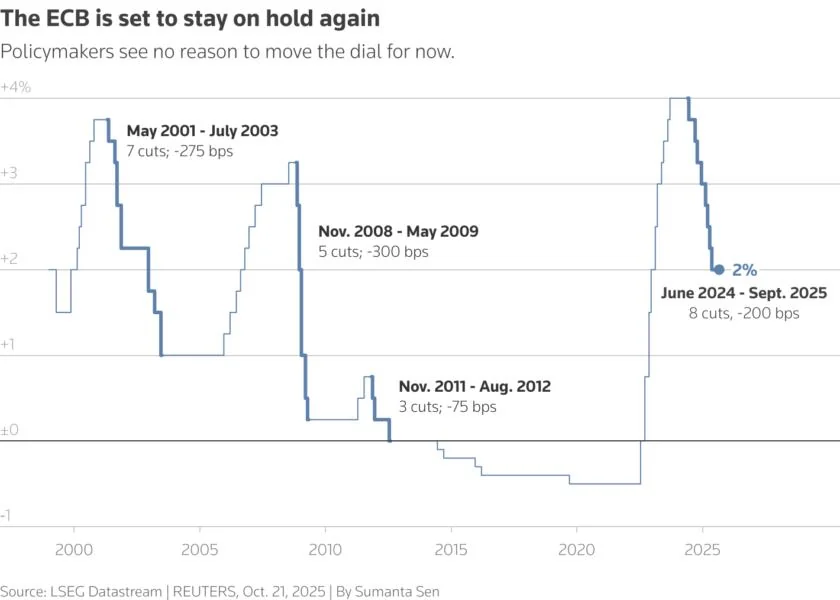
On 21 July 2022, the European Central Bank's Governing Council raised all three of its key interest rates by 50 basis points, a finance-sector decision that ended almost eight years of a negative deposit rate in the euro area. The ECB's own press release sets the resulting levels precisely: the main refinancing rate to 0.50%, the marginal lending facility to 0.75%, and the deposit facility rate to 0.00%, effective 27 July 2022. Moving the deposit rate from negative to exactly zero is the specific, statable fact; describing it as 'ending negative rates' is a shorthand the release supports but does not use in those words.
The evidence
The press release is the ECB's own account of its own decision, the strongest possible source for what was decided and when, but not an independent assessment of why the increase was 50 basis points rather than the 25 the Governing Council had signalled previously. The release describes this as a 'frontloading' of the exit from negative rates, and states the size of the move allows a shift to a meeting-by-meeting approach, rather than the forward guidance the ECB had relied on before. That is the ECB's own framing of its reasoning, not a third party's interpretation.
Timeframe and confidence
Confidence in the rate levels and the effective date is high, because both come directly from the ECB's dated release. Confidence in what the move meant for borrowing costs across the euro area is lower from this source alone, because a policy rate decision changes the rate at which banks deposit with and borrow from the central bank; it does not itself state what happened to mortgage rates, lending rates or bond yields, each of which passes through at a different speed. This is an editorial distinction between the policy lever and its transmission.
What would change the reading
A subsequent ECB statistical release on bank lending rates across member states, dated after July 2022, would show how quickly the policy change reached borrowers. A later Governing Council statement describing whether the 'meeting-by-meeting' approach was retained or replaced by renewed forward guidance would show whether this was a one-off frontloading or a lasting change in how the ECB communicates.
- How long after a policy rate decision do euro-area mortgage and corporate lending rates typically move, and does that lag vary by country?
- Did the ECB return to forward guidance in later meetings, or keep the meeting-by-meeting approach it named in July 2022?
- What happened to bank deposit rates for households once the ECB's own deposit facility rate turned positive again?
The dated fact is a set of three rate levels and an effective date. Everything said about what the move meant for the wider economy depends on separate, later data about transmission, and that data sits outside the single press release opened here.
Source trail
- Monetary policy decisionswww.ecb.europa.eu · Source publication: 2022-07-21 · Retrieved 2026-09-16
States the 50 basis point increase, the three resulting rate levels, the effective date, and the ECB's own 'frontloading' framing.
- European Central Bank (homepage)www.ecb.europa.eu · Source publication: not established · Retrieved 2026-09-16
Confirms the ECB as the issuing institution and living source for subsequent monetary policy decisions.
- Event date
- 2022-07-21
- First source date
- 2022-07-21
- Source-record publication
- Not supplied — draft retained
- Preparation
- 2026-09-16