digialps.com · Original source page
Image provenance
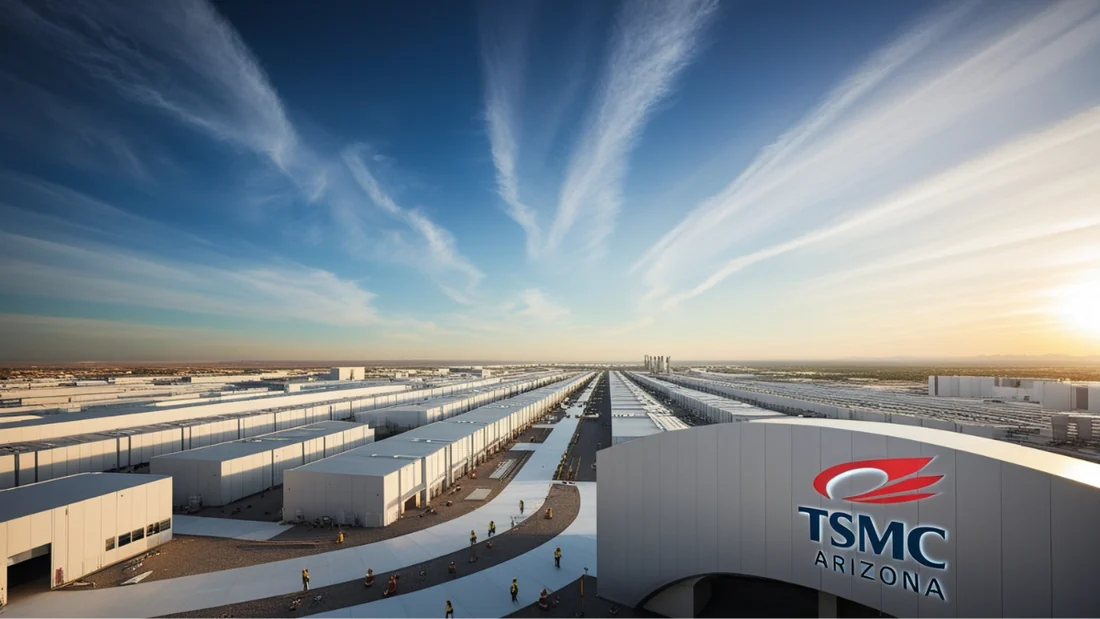
Inherited source visual. Image capture date and exact event relationship were not established again in this expansion. Owner publication review pending; credit does not grant permission.
Original assetThe signal
On 15 May 2020, TSMC announced plans to build a fab in Arizona using 5-nanometer technology, with a target capacity of 20,000 wafers per month, an investment of 'approximately US$12 billion from 2021 to 2029,' and production targeted to begin in 2024, part of Signal Atlas's semiconductor sector. The announcement projected more than 1,600 direct high-tech jobs.
The evidence
On 6 December 2022, TSMC announced an expansion of the same site: a second fab using 3-nanometer technology, targeted to begin production in 2026, alongside the first fab's N4 process targeted for 2024. Total investment across both fabs rose to 'approximately US$40 billion,' which the release calls the largest foreign direct investment in Arizona's history, with combined planned capacity of 'over 600,000 wafers per year' once both are complete and an additional 10,000 jobs, including 4,500 direct TSMC roles. Comparing the two releases shows the project's scale, measured in dollars, roughly tripled between the initial announcement and the expansion, before either fab had begun production. Both figures are TSMC's own newsroom statements about planned, not completed, capacity.
Timeframe and confidence
Both announcements are dated and specific about technology node, targeted capacity, and targeted production years, which supports confidence in what TSMC said it planned at each point. Confidence in the figures as a description of what was actually operating is necessarily lower until a production-start date is confirmed by a later TSMC statement, since the 2024 and 2026 targets named here were themselves still forward-looking when made.
What would change the reading
A TSMC statement confirming volume production began in Arizona, with output or yield figures, would convert the announced capacity into a measured one. A further delay announcement, of the kind seen at other advanced fabs during ramp-up, would weaken confidence that announced timelines translate directly into production dates.
- Did TSMC confirm volume production started in Arizona on or near the 2024 and 2026 targets stated in these releases?
- How does the cost per wafer of Arizona capacity compare with TSMC's home fabs, and does the company disclose that gap?
- Does a foreign chipmaker's announced US capacity change where its most advanced nodes are actually manufactured, or only where a trailing node is replicated?
An announcement fixes what a company says it intends to build. Only a later, separately dated statement about production can say whether intention became output.
Source trail
- TSMC Announces Intention to Build and Operate an Advanced Semiconductor Fab in the United Statespr.tsmc.com · Source publication: 2020-05-15 · Retrieved 2026-09-16
States the original 5nm, 20,000 wafer-per-month, US$12 billion Arizona fab plan with a 2024 production target.
- TSMC Announces Updates for TSMC Arizonapr.tsmc.com · Source publication: 2022-12-06 · Retrieved 2026-09-16
States the expanded second-fab plan, the roughly US$40 billion total investment, and combined wafer-per-year capacity.
- Event date
- 2020-05-15
- First source date
- 2020-05-15
- Source-record publication
- Not supplied — draft retained
- Preparation
- 2026-09-16